PDF · 1 A4 page
Visual cheat sheet
Print the five-step conversation guide and reminders about grief, choice and boundaries.
Download PDF: Visual cheat sheetThese resources support self-awareness, better conversations and community connection. Use them to pause, name what you need, listen with care through grief or choose a manageable next step. You can also bring people together through Walk & Connect or Coffee & Tea Connect.
They are not diagnostic tools, counselling or crisis support. If you are unsafe, cannot cope, or there is a risk of harm, seek appropriate urgent or professional support.
Sawubona coaching resource · Resource 11
A visual 90-minute lesson to explore the connection you need, map your support, practise listening with permission and choose one manageable step towards belonging.
Explore familiar sayings about shared support through original activities. A wider circle can offer more options. Trust, respect and the kind of connection matter too.
Use the editable slides, facilitator guide, printable workbook and shareable reminder sheet with adult community groups, workplaces or coaching clients. People can write, draw, use a fictional example or pass.
Explore the lesson & downloadsAdults · 90 minutes · Optional sharing · Private reflection · Practical next steps
Sawubona community resource · Resource 10
Seeing the person behind the silence.
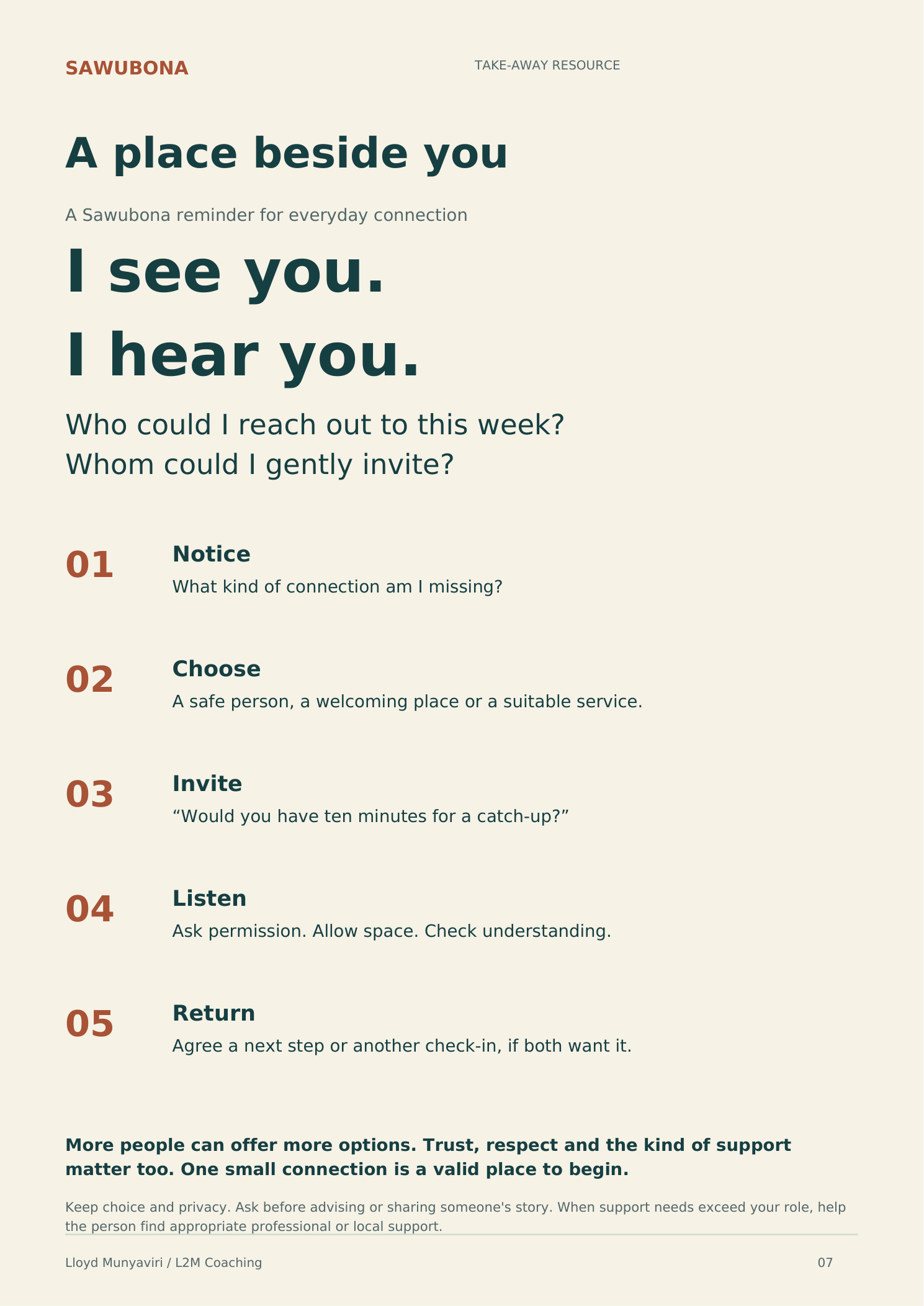
Check the assumptions you make when someone goes quiet. Offer a conversation with permission, listen at their pace and agree the support they want.
Use the visual cheat sheet in an everyday conversation. The full resource includes an original reflection, listening prompts, boundaries and an optional 30-minute group activity using a fictional scenario.
The person chooses what to share. Community listening supports connection; professional or urgent support may also be needed.
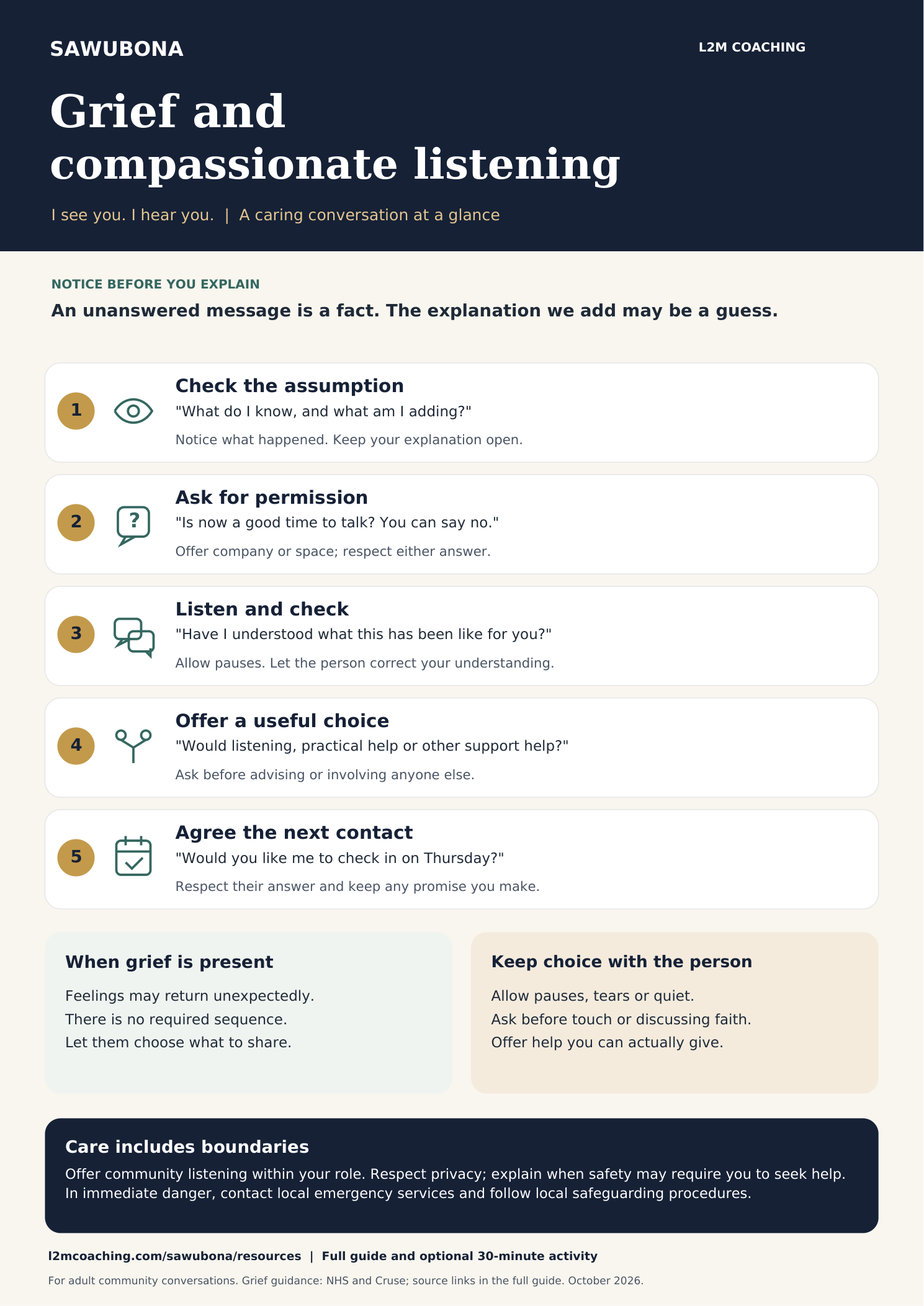
PDF · 1 A4 page
Print the five-step conversation guide and reminders about grief, choice and boundaries.
Download PDF: Visual cheat sheetPNG image
Save the cheat sheet to your phone or share it with someone preparing to listen.
Download image: Shareable visual guidePDF · 3 pages
Read the original reflection, follow the conversation guide and run the optional 30-minute activity.
Download PDF: Full resource and activityWord · DOCX
Adapt the facilitator wording for your setting, keeping permission, privacy and local support arrangements clear.
Download Word copy: Editable facilitator copySawubona community resource · Resource 09
Host a community morning or afternoon wherever you live. Bring people together over a drink, respectful listening and quiet company, with no pressure to share.
Download the one-page host cheat sheet, then use the full guide for planning, supplies, welcome scripts, 90-minute and three-hour formats, optional activities and your local organiser planner.
Free to attend · All activities optional · Adapt locally · Community connection with clear boundaries
Sawubona community resource · Resource 08
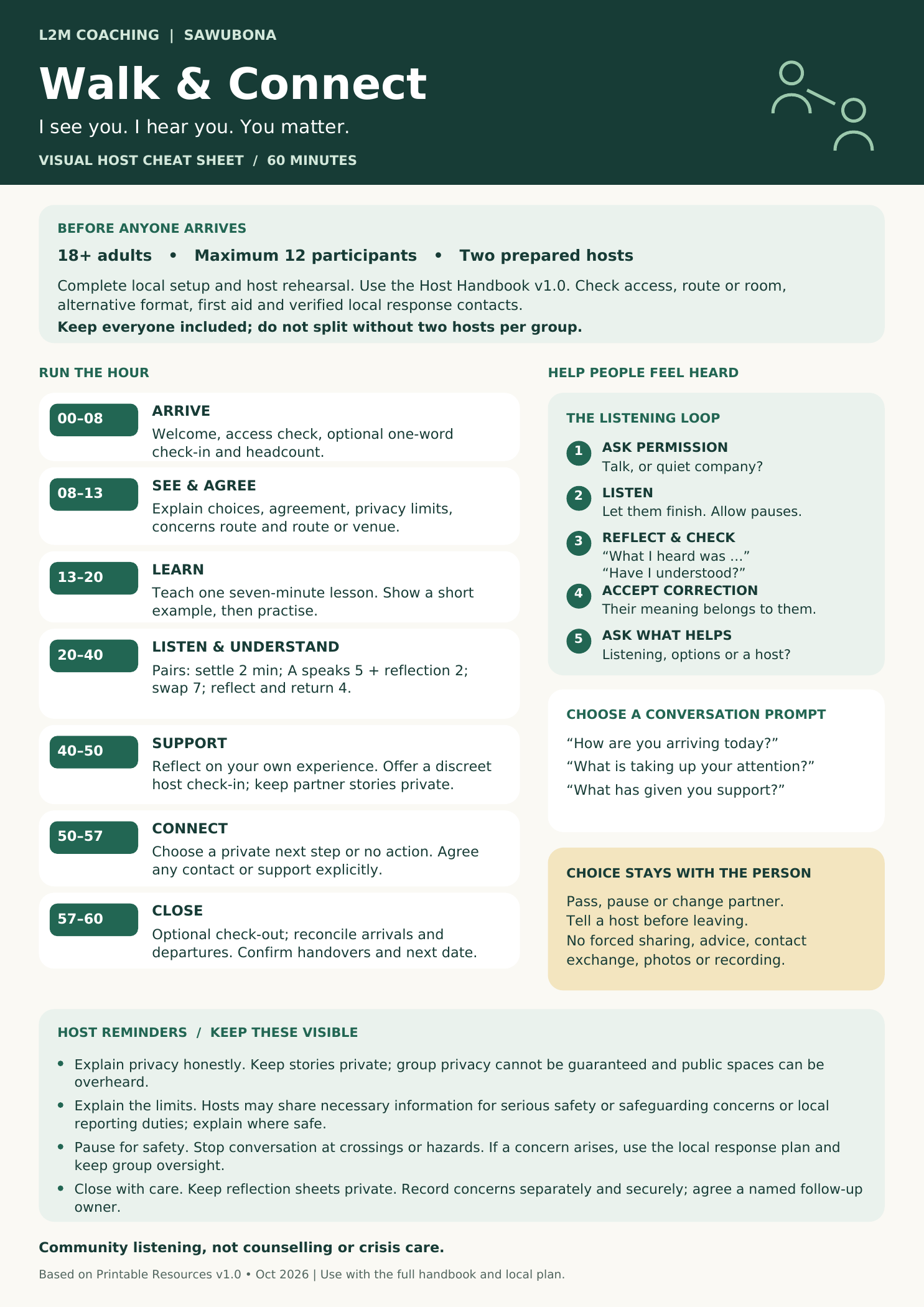
A repeatable 60-minute gathering where adults practise listening, share only what they choose and consider a next step in their own time. Walk, wheel or sit together in a format that includes everyone.
The visual cheat sheet is your guide during the hour. Use it alongside the host handbook and printable pack to prepare your hosts, agree the local arrangements and keep the listening practice consistent.
Community listening and connection. Host preparation supports this activity; it does not confer a Sawubona Practitioner qualification.
Sawubona Self-Resources · Resource 01
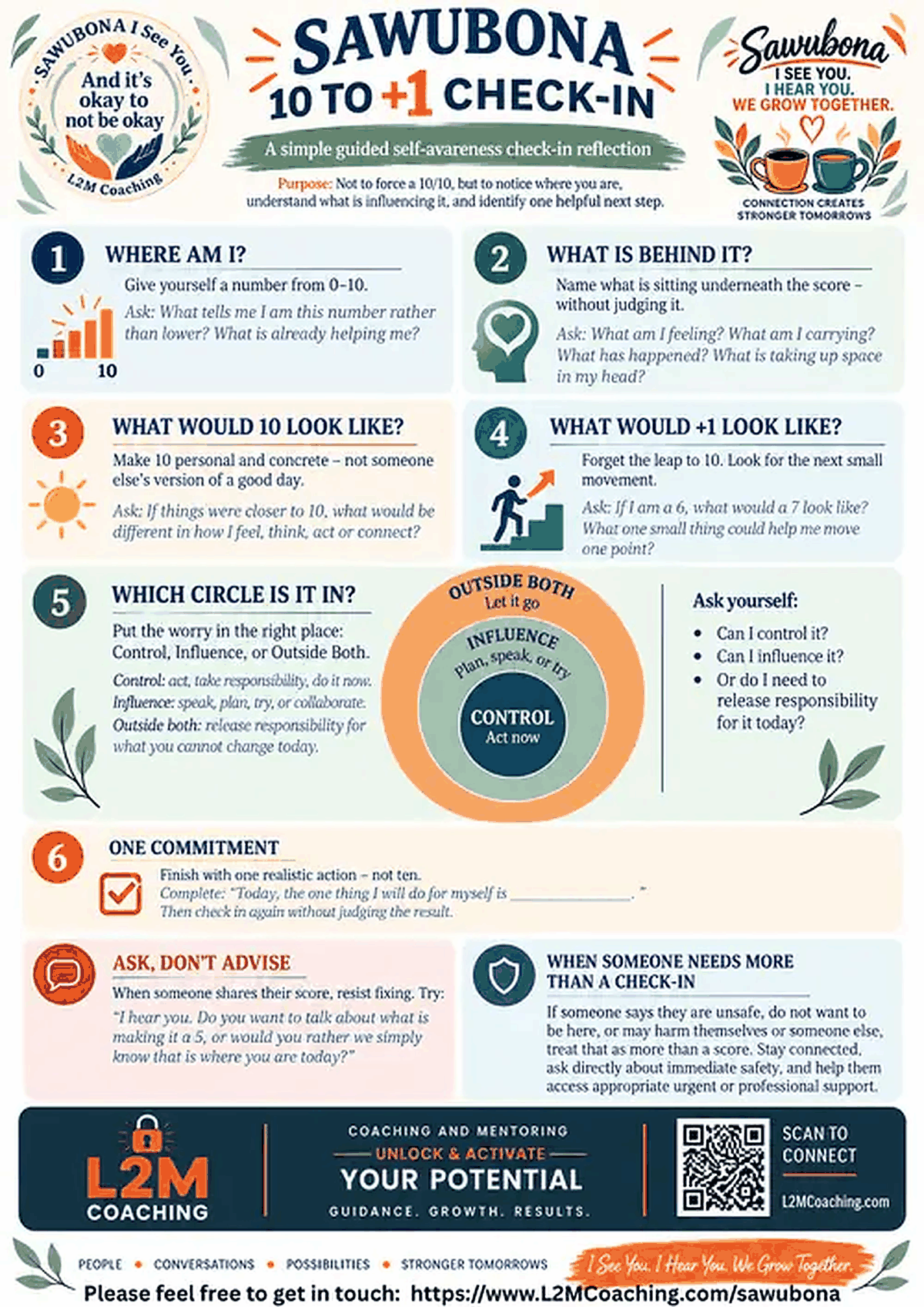
Sometimes “I’m fine” is the end of the conversation. Sometimes it is only the first answer. The Sawubona 10 to +1 Check-In is a short, self-guided reflection tool that helps a person name where they are, notice what is influencing that number and identify one realistic next step.
It is designed to support self-awareness and better conversations — not to diagnose, counsel or fix someone. Use it for yourself, share it with a colleague, family member or community, or use individual questions as prompts when someone wants help thinking about what comes next.
The aim is not to force a 10/10. It is to notice, understand and find the next +1.
Score
Where am I right now?
See
What is sitting behind the number?
Act
What is one helpful +1 step?
Feel free to use it, adapt it, take what helps and leave what doesn’t. If the conversation needs to go deeper, reach out and we can explore it together.
If a check-in reveals immediate safety concerns or risk of harm, treat it as more than a score and seek appropriate urgent or professional support.
Sawubona Self-Resources · Resource 02
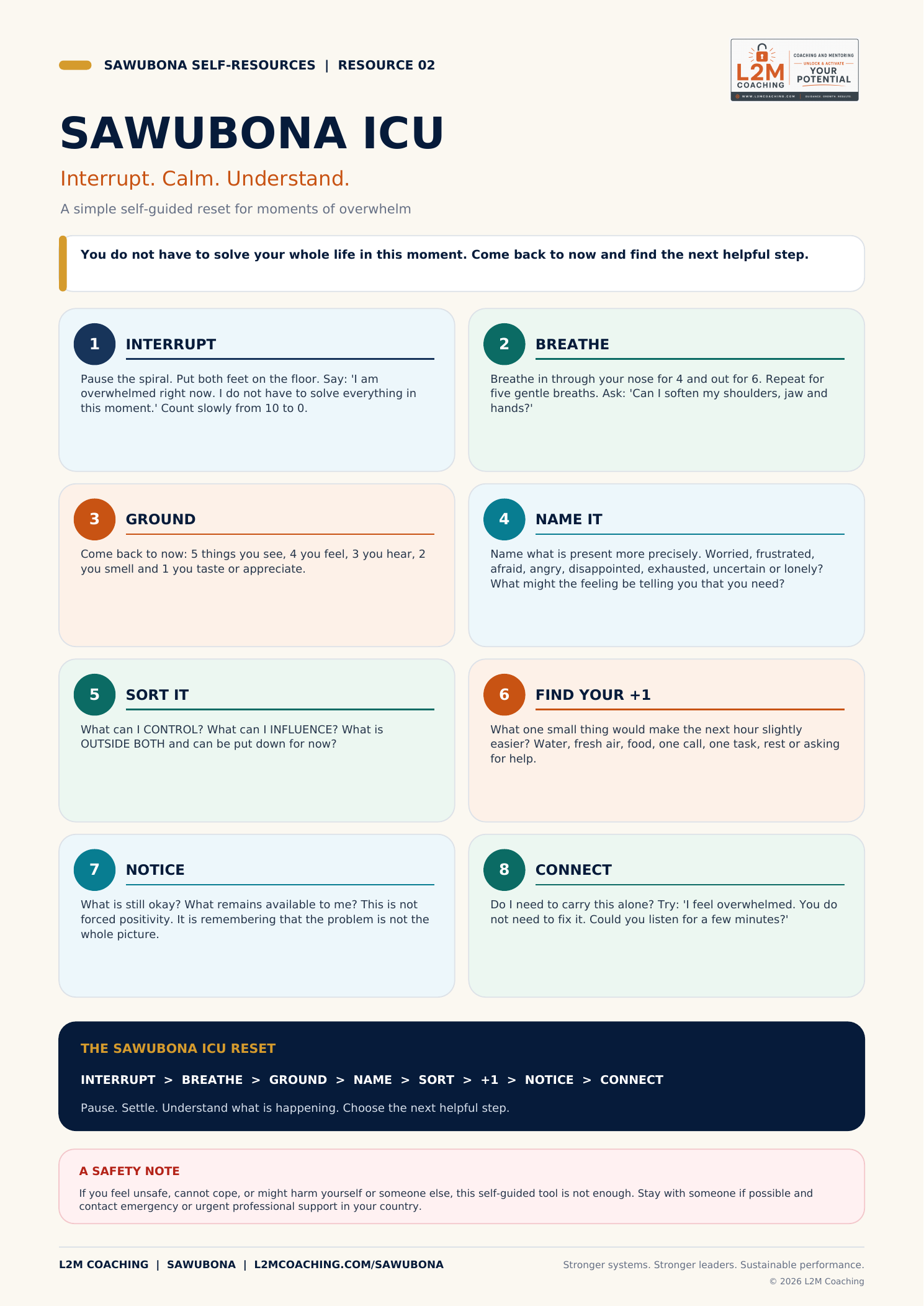
Sometimes overwhelm arrives faster than our ability to make sense of it. Thoughts speed up, everything can feel urgent, and we may try to solve too much at once, react quickly, withdraw or feel stuck.
Sawubona ICU helps create a little space between what you are experiencing and what you do next. It is not about pretending everything is okay, suppressing difficult emotions or forcing positive thinking. It helps you pause, settle, understand what is happening and identify the next helpful step.
You do not have to solve your whole life in this moment. Come back to now. Find the next helpful step.
The eight-step reset
Interrupt
Pause the spiral and create a little space.
Breathe
Settle the body with gentle, slower breathing.
Ground
Bring your attention back to the here and now.
Name it
Get more specific about what you are feeling and needing.
Sort it
Separate what you can control, influence or put down for now.
Find your +1
Choose one manageable next step rather than solving everything.
Notice
Remember what is still okay and what remains available to you.
Connect
Decide whether you need to carry this alone.
A safety note
If overwhelm becomes a feeling that you are unsafe, cannot cope, or might harm yourself or someone else, this self-guided tool is no longer enough. Stay with someone if possible and seek appropriate emergency, urgent or professional support where you live.
Sawubona Self-Resources · Resource 03
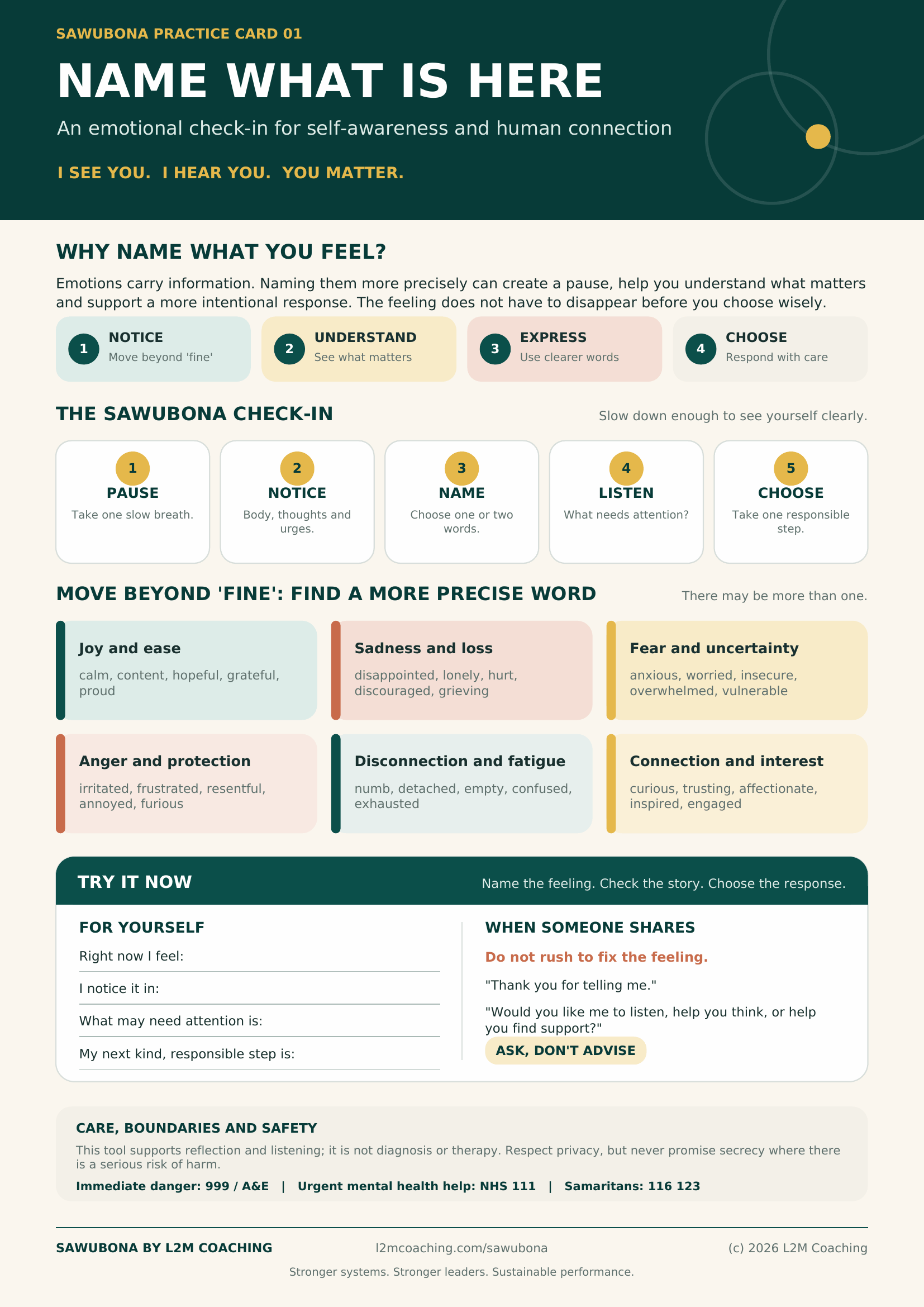
“Fine”, “stressed” and “angry” can be useful starting points, but they may not tell the whole story. You might be disappointed, lonely, anxious, overwhelmed, frustrated, grateful, hopeful or exhausted.
Naming an emotion more precisely does not make it disappear. It can create a pause, help you understand what matters and make it easier to communicate or choose what you do next.
Before I can say “I see you”, I must also be willing to see what is happening within me.
Notice
Move beyond the automatic “I’m fine”.
Understand
Recognise what matters or needs attention.
Express
Use clearer language with yourself and others.
Choose
Create a pause before deciding how to respond.
The five-step check-in
Pause
Take one slow breath and create a little space.
Notice
Pay attention to your body, thoughts and urges.
Name
Choose one or two words that fit what is present.
Listen
Ask what this emotion may need you to notice.
Choose
Take one kind, responsible next step.
Interactive coaching tool
Move from naming the emotion into body awareness, meaning, needs, control and a deliberate next response. Use it privately or alongside someone in a Sawubona conversation.
Open the Emotion CompassWhen someone shares
Do not rush to fix the feeling.
“Thank you for telling me.”
“Would you like me to listen, help you think, or help you find support?”
Ask, don’t advise.
Care, boundaries and safety
This is a reflection and supportive-listening tool, not diagnosis or therapy. Respect privacy, but never promise secrecy where there is a serious risk of harm. In immediate danger call 999 or go to A&E. For urgent mental-health help call NHS 111. Samaritans are available on 116 123.
Sawubona Self-Resources · Resource 04
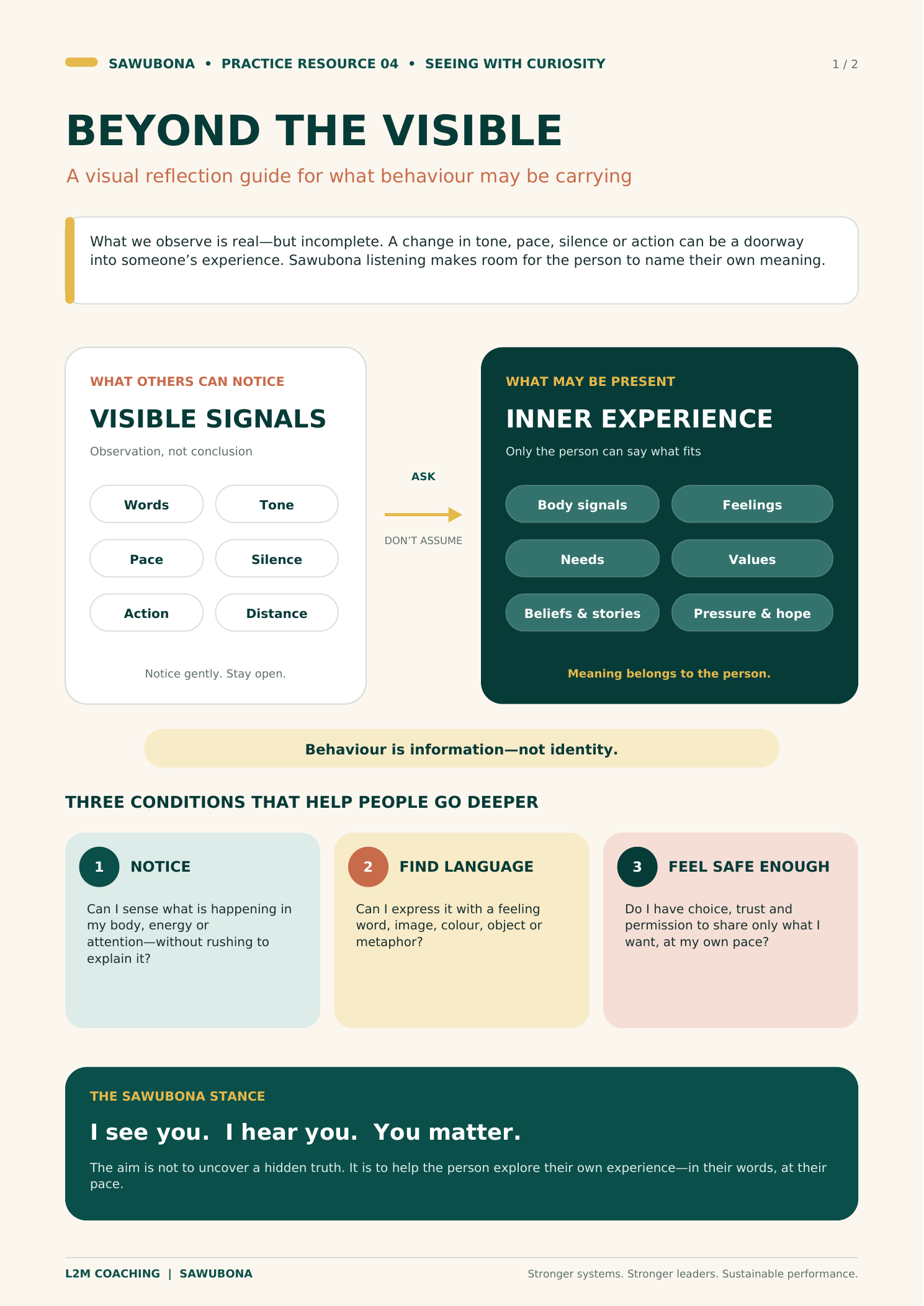
Words, tone, pace, silence and action are real signals, but they may not tell the whole story. This resource helps you stay curious about the feelings, needs, values, body signals and pressures that may be present without making assumptions about another person.
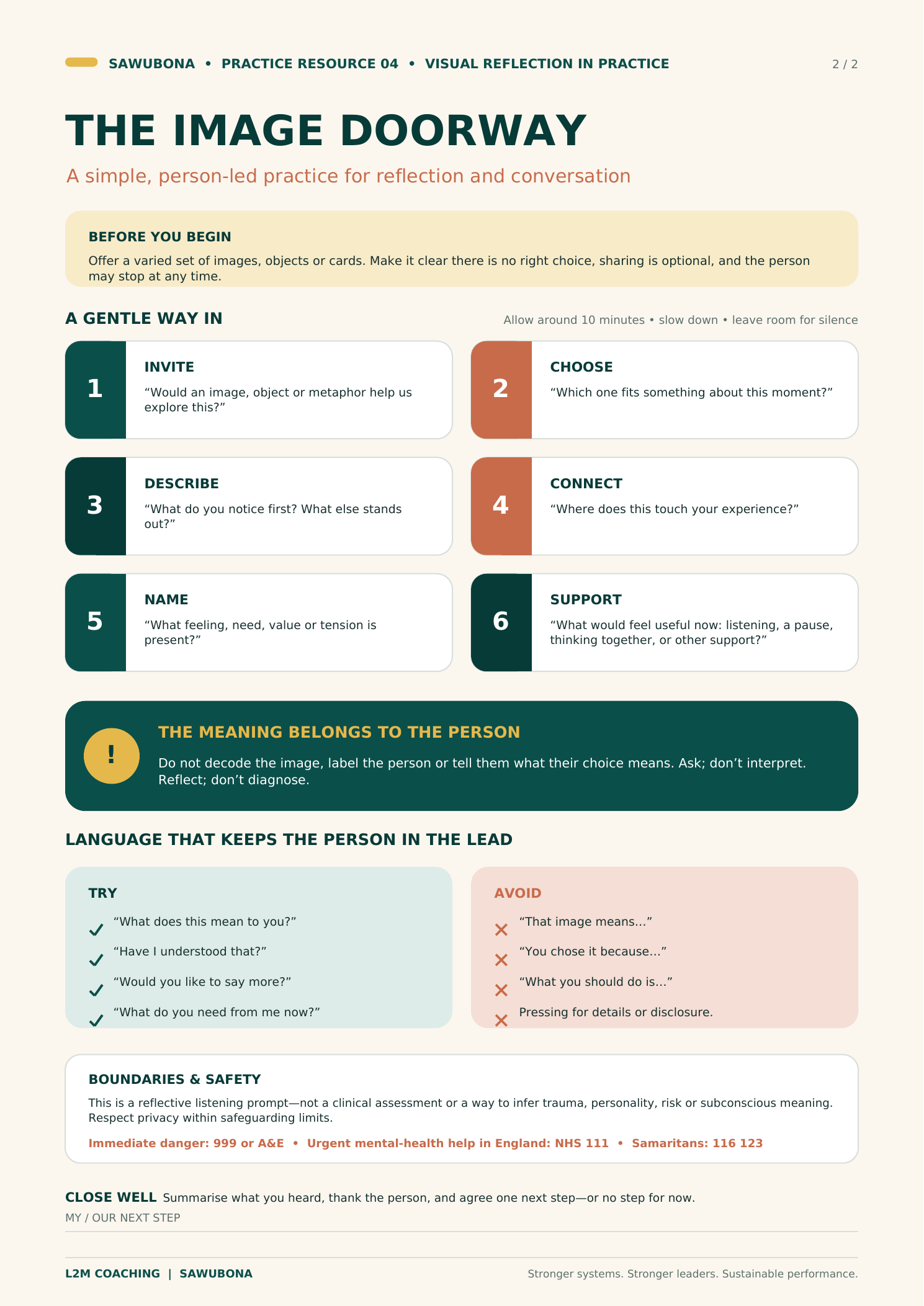
The Image Doorway uses a picture, object or metaphor to help someone explore their own experience. The person chooses what it means. The listener asks, reflects and never interprets or diagnoses.
Behaviour is information—not identity.
Notice
Sense what is happening in your body, energy or attention.
Find language
Use a feeling word, image, colour, object or metaphor.
Feel safe enough
Keep choice, trust and permission at the centre.
The Image Doorway
Invite
Ask whether an image, object or metaphor would help.
Choose
Let the person select what fits this moment.
Describe
Explore what they notice first and what stands out.
Connect
Ask where the image touches their experience.
Name
Notice any feeling, need, value or tension present.
Support
Agree what would feel useful now or next.
The golden rule
The meaning belongs to the person.
Ask “What does this mean to you?” Never tell someone what their image choice reveals about them.
Ask; don’t decode. Reflect; don’t diagnose.
Care, boundaries and safety
This is a reflective listening prompt, not a clinical or projective assessment and not a way to infer trauma, personality, risk or subconscious meaning. Participation is optional. In immediate danger call 999 or go to A&E. For urgent mental-health help in England call NHS 111. Samaritans are available on 116 123.
Sawubona Self-Resources · Resource 06
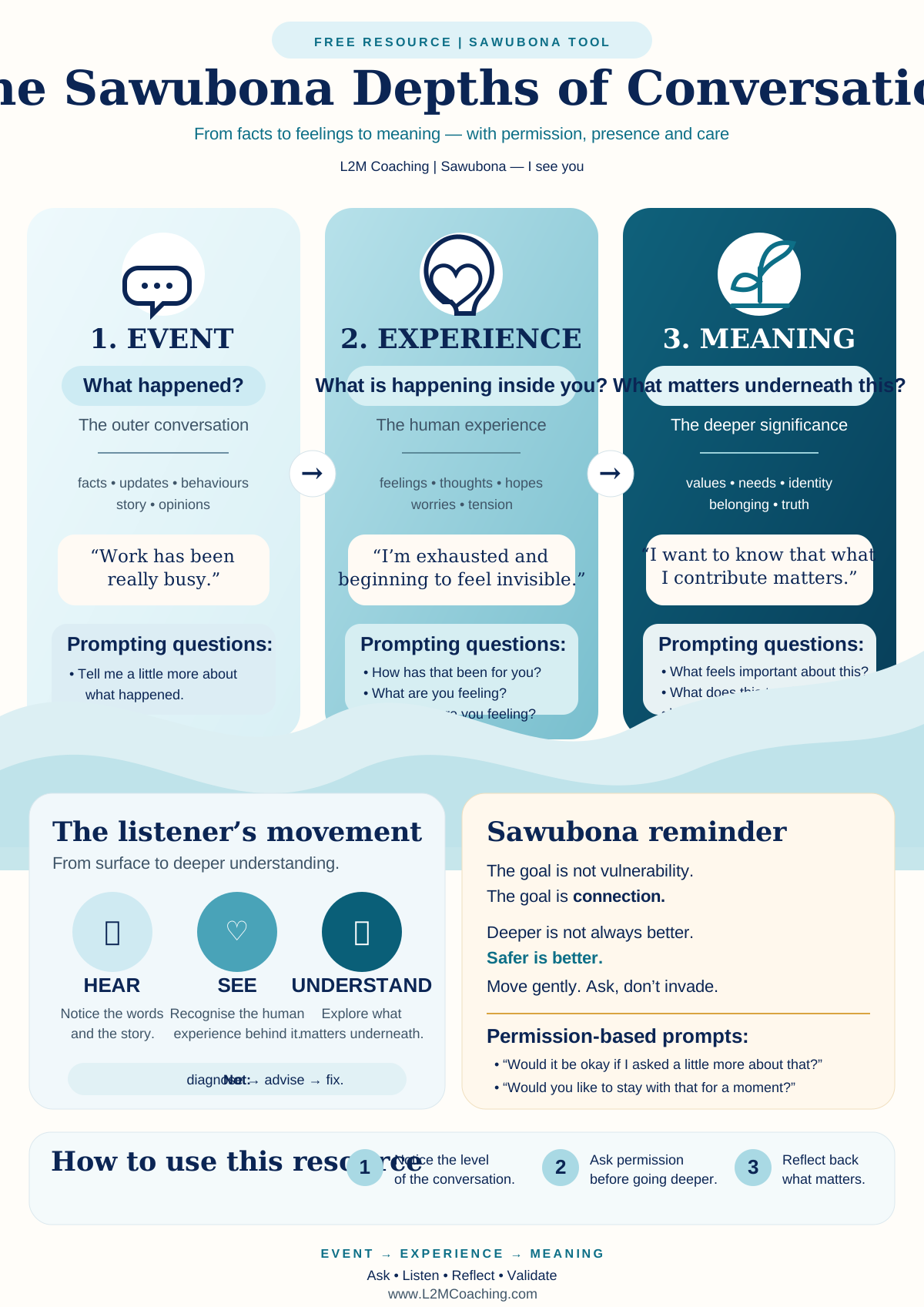
Some conversations stay at the level of facts and updates. Others become more meaningful when there is enough permission, presence and safety to explore what the experience feels like and what matters underneath it.
This tool gives listeners a simple way to notice the depth of a conversation without forcing vulnerability. The person speaking stays in control of how far the conversation goes.
The goal is not vulnerability. The goal is connection.
Event
What happened?
Facts, updates, behaviours, actions and the story being told.
Experience
What is happening inside you?
Feelings, thoughts, worries, hopes, tension and the human experience behind the event.
Meaning
What matters underneath this?
Needs, values, identity, belonging, dignity, purpose and what feels most important.
The listener’s movement
Hear → See → Understand
Hear the words and story. See the human experience behind the story. Understand what may matter underneath — without diagnosing, interpreting or rushing to fix.
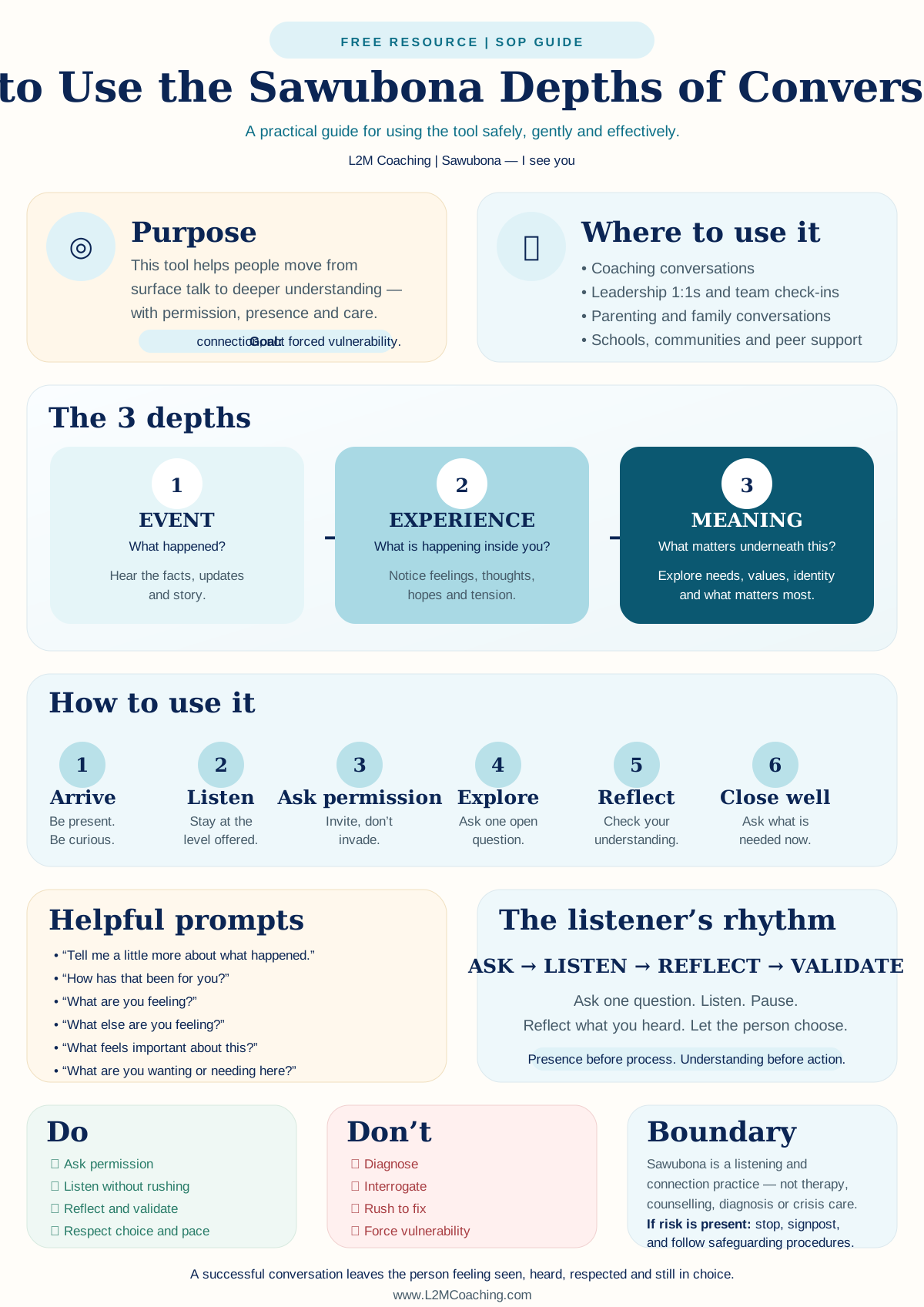
How to use it
Arrive
Be present, curious and unhurried. Make sure the setting feels appropriate.
Listen at the level offered
Do not force depth. Begin with the story the person is already telling.
Ask permission
Invite a deeper question rather than assuming the person wants to go there.
Explore gently
Ask one open question, pause and allow silence rather than filling the space.
Reflect back
Name what you think you heard and check whether you have understood correctly.
Close well
Ask what the person needs now and agree any appropriate next step, support or signposting.
Permission-based prompts
The listening rhythm
Ask → Listen → Reflect → Validate
Ask one question. Listen. Pause. Reflect what you heard. Let the person decide where the conversation goes next.
Care, boundaries and safety
Sawubona is a listening and connection practice. It is not therapy, counselling, diagnosis or crisis intervention. Do not force disclosure or probe for trauma. If there is immediate danger, safeguarding concern or serious mental-health crisis, stop exploratory listening, seek appropriate support and follow safeguarding procedures.
Sawubona Self-Resources · Resource 07
What we see on the surface may be only part of the story. Anger, silence, withdrawal, smiling, confidence and calm can all connect to different feelings, needs and experiences underneath.
This interactive tool lets you click a behaviour, feeling or need and explore several possible connections in either direction. It includes pleasant emotions as well as difficult ones, so the conversation is not framed only around distress.
Behaviour is information—not proof.
Notice
Start with the behaviour you can actually see.
Explore
Consider several possible feelings or needs underneath.
Respond
Use a Sawubona prompt, question and next-step action.
The Sawubona movement
Notice → Ask → Listen → Reflect → Validate → Respond
The tool does not tell you what someone is feeling. It helps you move away from assumption and towards a better question.
Care, boundaries and safety
This is a reflective coaching and listening resource, not a clinical assessment. Do not use behaviour to infer trauma, diagnosis, risk or intent. If there is immediate danger, a safeguarding concern or a serious mental-health crisis, follow the appropriate safeguarding or emergency process.
Return to the programme