When someone is grieving
Let them choose whether to talk about the person who died. Avoid instructions such as "Move on", comparisons with your own loss, or assurances about how they should feel.

L2M Coaching · Community resource 10
Seeing the person behind the silence.
A practical guide for adult conversations in families, workplaces and communities. Check your assumptions, make room for the person's experience and agree support they want.
Start with the one-page visual guide, then use the reflection, conversation prompts or optional group activity below. The full PDF and editable Word copy are also available.
An original Sawubona reflection
We can notice an unanswered message. The meaning we attach to it is still a guess.
Someone who has gone quiet may be dealing with loss, exhaustion or a need for space. They may also have an explanation we have never considered. A gentle invitation gives them room to speak for themselves.
For someone living with grief, an ordinary moment can suddenly feel different. A familiar song or a celebration may bring the absence close again. Feelings can change unexpectedly, and there is no required order for them.
At Sawubona, we practise seeing and hearing the person without demanding an explanation. We can ask, "Would some company help, or would you prefer some space today?"
When they choose to speak, let them finish. When they choose silence, respect it. Offer practical help you can give, and ask before arranging anything.
If you are grieving, you can say what would help today. You are allowed to change your mind, keep a memory private or share a laugh without explaining yourself.
Make one kind invitation today, and leave the other person free to choose.
Sawubona. I see you. I hear you.
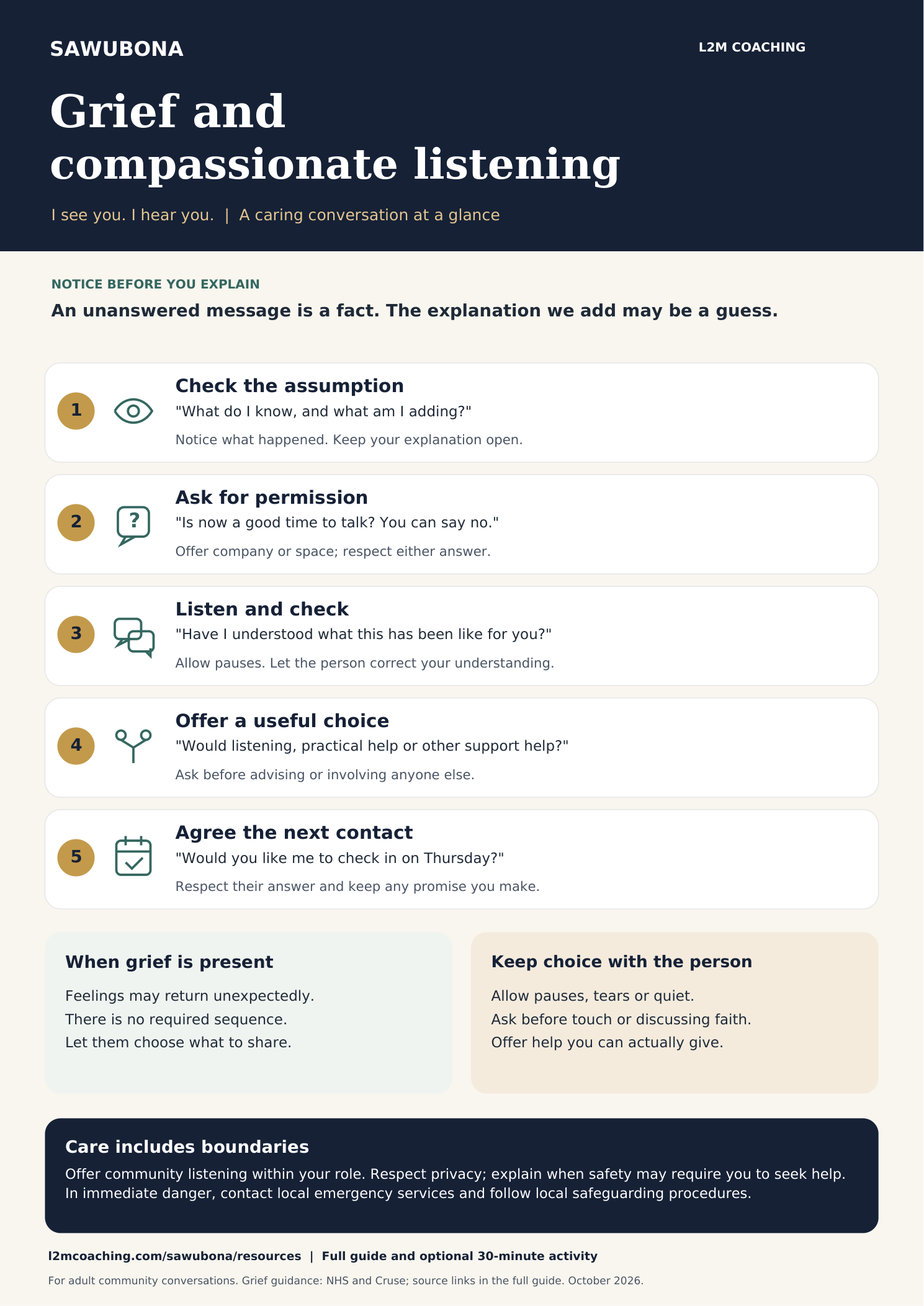
Use these with an adult who is willing to talk. Aim to understand their experience and agree support they want. Ask before advising.
"I sent a message on Monday and have not had a reply" is an observation. "They are rejecting me" is an interpretation. Keep them separate; ask rather than diagnose.
"Is now a good moment for a check-in? You can say no." Choose a private place and be honest about how much time you have.
"It sounds as though evenings have been especially difficult. Have I understood?" Let them correct you. Allow pauses; ask before discussing memories, faith or family.
"Would you like me to listen, help with something practical, or help you find other support?" Offer one specific task you can fulfil. Ask before giving advice or involving anyone else.
"Would you like me to message again on Thursday?" Follow their preference and keep the commitment. If they decline contact, respect their boundary.
Let them choose whether to talk about the person who died. Avoid instructions such as "Move on", comparisons with your own loss, or assurances about how they should feel.
Keep personal information private. Explain that you may need to seek help if someone is in danger or a safeguarding concern arises. Compassion can sit alongside clear boundaries about harmful behaviour.
If distress is getting harder to manage or daily life is difficult, encourage contact with a healthcare professional or bereavement service. In immediate danger, contact local emergency services and follow local safeguarding procedures. Do not manage an emergency alone.
Optional practice · 4-12 adults · 30 minutes
For 4-12 adults. Use a facilitator confident in group listening and responding to distress. Choose a quiet, accessible space; bring paper, pens and a clock. Identify a safeguarding lead and current local support services. Participants may pass, step out or use only the fictional example. Do not record the session.
A colleague has stopped joining lunch since a bereavement. You have begun assuming they want everyone to leave them alone. How could you check that assumption without asking them to explain their grief?
Nobody needs to disclose a personal loss. Use this scenario throughout if that feels more comfortable.
0-4 min
Explain the purpose, the right to pass and the limits of privacy when safety is at risk. Ask people to avoid sharing identifying details about others.
4-9 min
Read the scenario below. On paper, make three columns: What I observed / The explanation I added / A respectful question I could ask.
9-19 min
In pairs, take turns as listener and speaker using the fictional scenario. Allow 4 minutes per turn, then 2 minutes together to discuss what helped.
19-26 min
Each pair creates one offer of practical help, checks permission and agrees whether a follow-up would be welcome. Share the wording without personal stories.
26-30 min
Invite one voluntary learning point, with permission to pass. Remind people where they can seek local support and allow time for a private check-in.
Ask yourself: Did I describe what I observed? Did I give the person a real choice? Did I check my understanding before offering help?
Use these prompts for community listening, not for diagnosing or treating grief. Adapt language and customs with participants; do not require eye contact, touch or a particular way of expressing emotion.
Print the cheat sheet, keep the image on your phone, or use the full guide to prepare a conversation or activity. The editable copy supports local facilitation.
PDF · 1 A4 page
Print the five-step conversation guide and reminders about grief, choice and boundaries.
Download PDF: Visual cheat sheetPNG image
Save the cheat sheet to your phone or share it with someone preparing to listen.
Download image: Shareable visual guidePDF · 3 pages
Read the original reflection, follow the conversation guide and run the optional 30-minute activity.
Download PDF: Full resource and activityWord · DOCX
Adapt the facilitator wording for your setting, keeping permission, privacy and local support arrangements clear.
Download Word copy: Editable facilitator copyOriginal Sawubona reflection, conversation prompts and activity by Lloyd Munyaviri at L2M Coaching. General grief guidance was checked against the following sources on 21 October 2026.