PDF · 1 page
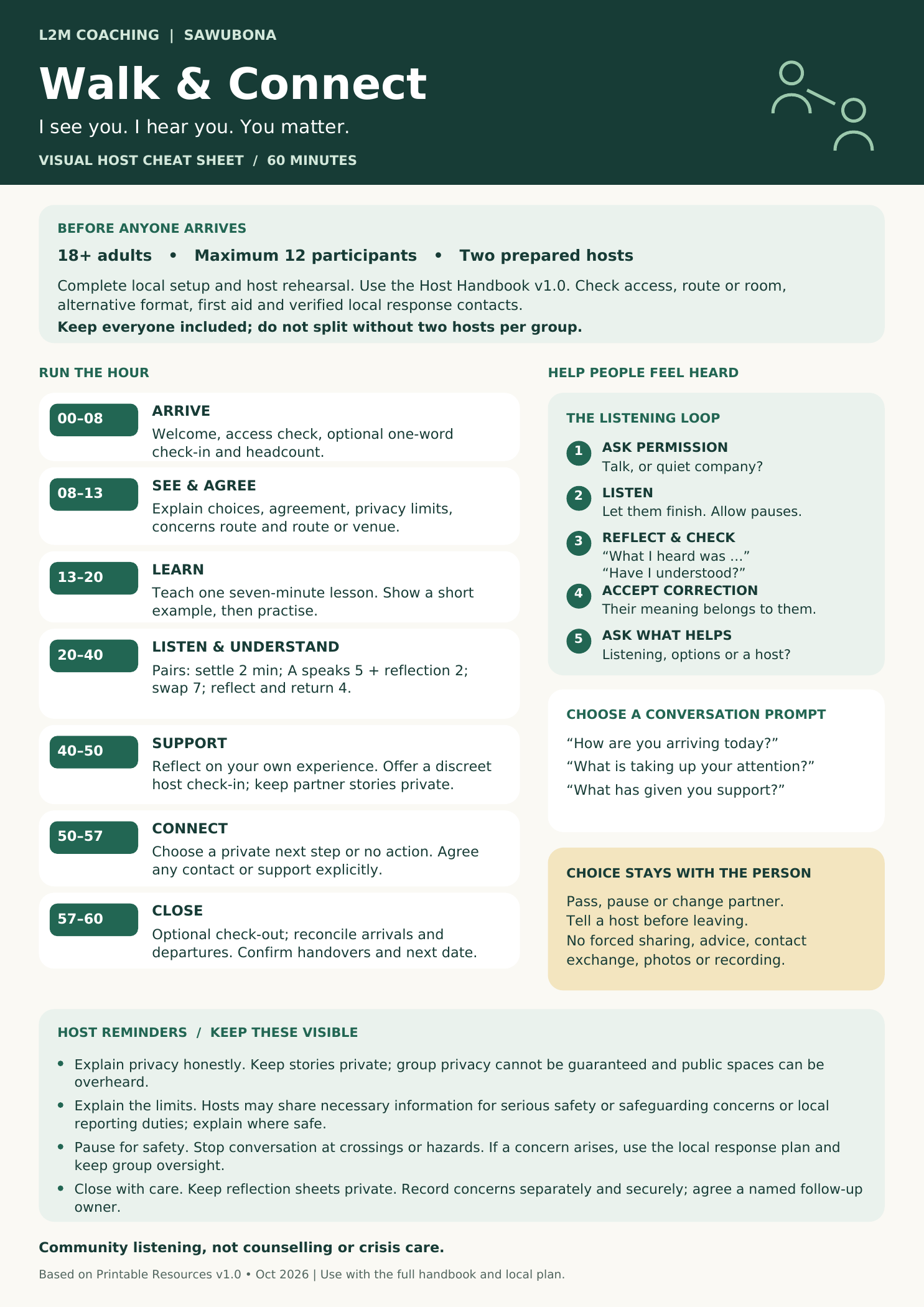
Visual host cheat sheet
Keep the timetable, listening loop and host reminders beside you during the session.
Download PDF: Visual host cheat sheet
L2M Coaching · Sawubona community resource · 08
I see you. I hear you. You matter.
A Sawubona gathering brings people together to practise listening and experience being heard. Each hour includes a short lesson, equal optional conversation turns, private reflection and a gentle close.
A practical way to bring “I see you, I hear you” into everyday community life. People take turns speaking and listening, without pressure to disclose, achieve a goal or explain themselves to the group.
A gentle walk or wheel is one option. A fully seated meeting uses the same listening practice. Choose a checked format that includes the whole group; do not split the group unless each separate group has two prepared hosts.
Community organisers, adult groups and workplace or neighbourhood hosts who can complete the preparation and local arrangements. Participants need no coaching experience and may speak, listen quietly, pause or pass.
This adult pilot offers community listening and connection. It does not provide counselling, diagnosis or crisis care. Preparing to host this activity does not qualify someone as a Sawubona Practitioner.
Work with under-18s requires a separately designed safeguarding and delivery plan; this handbook does not cover it.
Before the first invitation
The cheat sheet helps you remember the session. The handbook and completed local plan provide the preparation behind it. Resolve the launch requirements before inviting people.
Read the operating standard and scripts together. Use the 75-minute host orientation, observed rehearsal and readiness sheet. Route checks and local service checks happen separately.
Name the organiser, lead host and supporting host. Check the route or room, access, seating, toilets, weather alternative, first-aid provision and cancellation arrangements.
Verify emergency, safeguarding and routine support contacts. Agree who supports a person, who oversees the group and how concerns are recorded securely.
State the precise meeting point, time, format, access information, any costs and contact details. This pilot is for adults 18+, with a maximum of 12 participants excluding the two hosts.
Your session at a glance
Times below are minutes from the start. Keep the agreement, equal optional turns and complete close in every session. Stop conversations at crossings or hazards and attend to the route.
Welcome people, check access needs and count arrivals. Offer an optional one-word check-in.
Explain the choices, group agreement, privacy limits, concerns route and walking route or venue before anyone shares.
Teach one seven-minute listening lesson: explain the skill, demonstrate it with an everyday example and practise briefly.
Settle in pairs for 2 minutes. A may speak for 5 minutes, then receive 2 minutes of reflection and checking. Swap for 7 minutes; use the final 4 minutes to reflect and return.
Reflect on your own experience of listening or being heard. Keep your partner’s story private. Offer a discreet host check-in.
Choose a private, manageable next step, or choose no action. Agree any further contact or support explicitly.
Offer an optional check-out, reconcile arrivals and departures, confirm any support handovers and announce the formal close.
The listening loop
“Would you like to talk, or would quiet company suit you?”
Let the person finish. Give pauses room without deciding what they mean.
“What I heard was … Have I understood?” Use their words rather than an interpretation.
Let them change or clarify your reflection. Their meaning belongs to them.
“Would you like listening, some options or support from a host?” Respect the answer.
Use a prompt, choose your own topic or pass. In the group reflection, describe your experience rather than your partner’s story.
Begin with permission and reflection. The handbook then offers lessons on naming feelings, making room for pauses, asking what support is wanted, caring with boundaries and choosing a manageable next step.
Keep the seven-minute lesson slot and revisit a skill when helpful. Use everyday or fictional examples; welcome newcomers without making personal disclosure part of the lesson.
Choose the local language, day, route or room. Offer walking, wheeling or seated participation while retaining participant choice, the listening lesson, equal optional turns, the local response plan and a complete close.
Start with a four-session pilot and review each meeting with your co-host. Before expanding, review access, participant feedback, concerns and host workload. Keep personal stories out of routine reviews.
Keep Sawubona and L2M Coaching attribution and the version details with any adapted materials. The pack does not grant practitioner, trainer, franchise or organisational accreditation.
Your host resource kit
Read the handbook first, complete the relevant sheets in the printable pack, then use the visual cheat sheet during the session. These resources work together.
PDF · 1 page
Keep the timetable, listening loop and host reminders beside you during the session.
Download PDF: Visual host cheat sheetPNG image
Save the visual guide to your phone or share it with your co-host.
Download image: Shareable cheat sheetPDF · 8 pages
Use the participant prompts, private reflection, local setup, risk and review sheets.
Download PDF: Printable resource packPDF · 19 pages
Start here for the operating standard, host preparation, scripts and six listening lessons.
Download PDF: Host handbookL2M Coaching · Pilot edition 1.0 · October 2026. Programme enquiries: info@l2mcoaching.com. This inbox is for programme enquiries and is not an emergency response route.
Explore the wider Sawubona programme