L2M Coaching · Community resource 09 · Edition 1.0
Coffee & Tea Connect. There is a chair for you.
I see you. I hear you. You matter.
Host a Sawubona morning or afternoon wherever you live. Bring people together over a drink, make room for conversation and welcome those who simply want company.
Any communityFree to attend90 minutes or 3 hoursAll activities optional
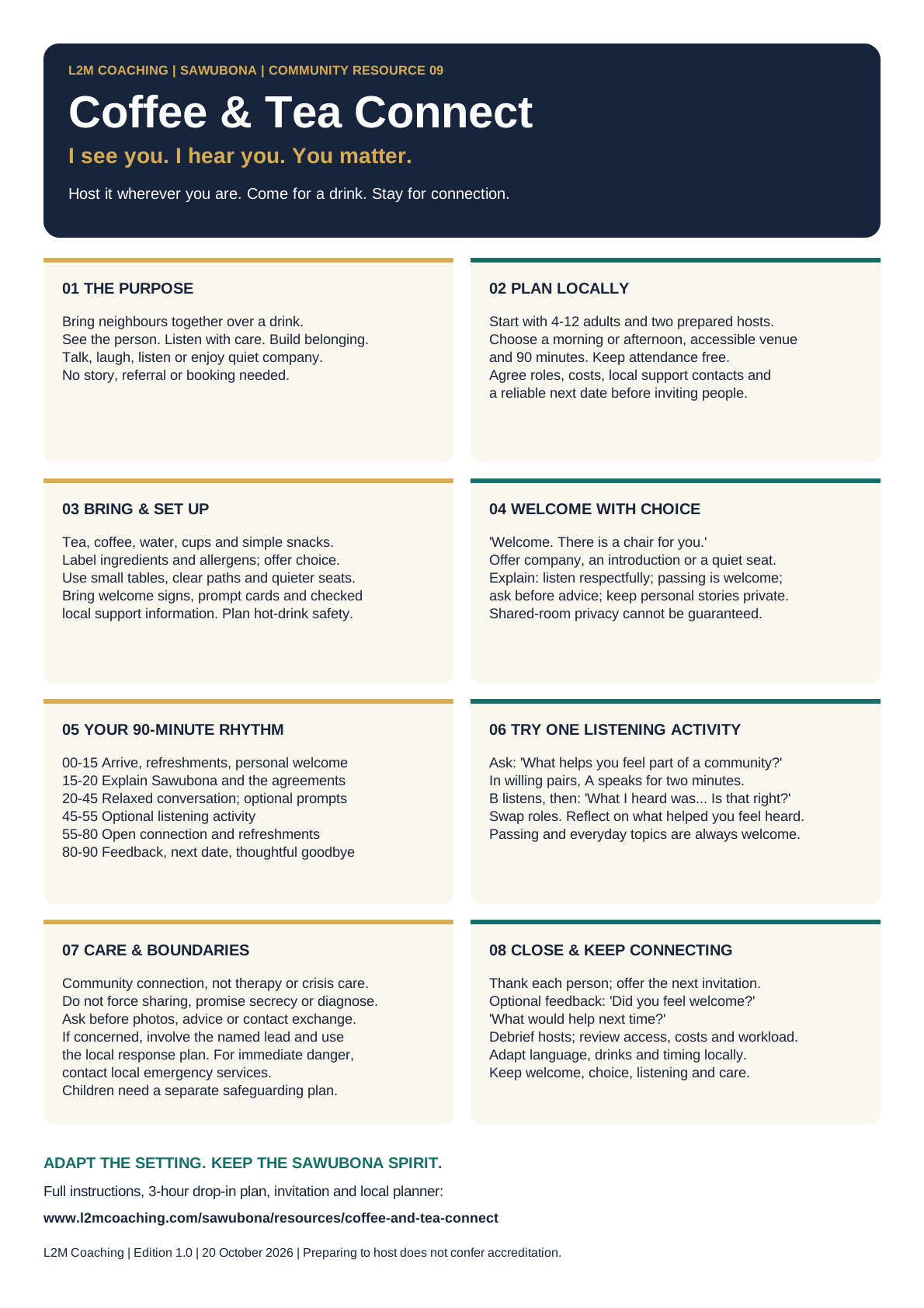
A4 host cheat sheet. Select to enlarge; download below.
What is it, and why bring people together?
Sawubona means “I see you”. Coffee & Tea Connect puts that welcome into everyday community life: an available chair, a drink and someone willing to listen. People can talk, laugh, listen or enjoy quiet company. They need no particular problem, prepared story or referral.
The purpose is to build relationships, make it easier to join in, practise respectful listening and help people discover local opportunities or support when wanted. Refreshments create the invitation; the quality of welcome creates the connection.
This resource grows from the Sawubona Coffee & Connect gathering held at The Hive, Whitehouse, Milton Keynes, on 10 October 2026, co-hosted with Empty Chairs. Use the reusable format in your own setting; name only the partners confirmed for your local event.
Who can host?
Neighbours, community volunteers, libraries, cafés, resident groups, charities, workplaces and faith communities can use the guide. Choose hosts who welcome warmly, listen without intruding, respect difference and know when to ask for help. No clinical qualification is needed for this community role; preparation and a local response plan are needed.
The starter plan is for adults. Family or youth gatherings need age-appropriate arrangements, named supervision and a separate safeguarding plan. Hosting this activity does not confer practitioner, trainer, franchise or organisational accreditation.
Before you invite people: eight planning steps.
01
Choose the scale
For a first gathering, start with 4–12 adults and two prepared hosts for 90 minutes. For a larger three-hour drop-in, plan around 20–30 guests across the session, within venue capacity, and increase the team.
02
Agree a place and time
Use an accessible community room, café, library space or another suitable local venue. Check permission, seating, toilets, transport, lighting, noise and a quieter area. Publish the precise meeting point and morning or afternoon times.
03
Name the team
Identify the lead and support host. At larger events, also assign welcome, refreshments and floating support roles. Name who handles safeguarding concerns; make sure someone can keep welcoming while another person helps a guest.
04
Set the budget
List venue, drinks, snacks, serving supplies, printing, access support and volunteer expenses. Confirm funding or donations before inviting people. Keep attendance free and any donations clearly optional.
05
Prepare the practical arrangements
Agree setup and clearing times, food and allergen information, hot-drink safety, first aid, venue emergency arrangements and cancellation communication. Check local and venue requirements rather than assuming the same arrangements apply everywhere.
06
Complete the local response plan
Verify local emergency, safeguarding, professional-support and routine community contacts. Agree who responds, who maintains group oversight and how necessary concerns are recorded securely. Do this before opening.
07
Invite warmly
Share the invitation below through local groups, noticeboards and personal invitations. No referral or booking is needed. Any optional RSVP is for planning, not a condition of attendance.
08
Rehearse, then open
Brief hosts and practise a lone arrival, someone becoming upset, a dominating conversation and the closing words. This guide prepares community hosts; it does not qualify someone as a Sawubona Practitioner.
Suggested preparation: secure the venue and team three to four weeks ahead; promote two weeks ahead; confirm roles and supplies one week ahead; brief hosts and check contacts before opening. For a small informal gathering, shorten the timetable while completing the same practical decisions.
What you need.
Tea, coffee and drinking water; milk and clearly labelled alternatives where available.
Cups, teaspoons, napkins, safe serving equipment and cleaning supplies.
Simple snacks with ingredient and allergen information; keep refreshments optional.
Small tables, comfortable chairs, clear walkways and quieter seating.
A welcome sign, identifiable hosts, optional prompt cards and checked local information.
A working phone, named event lead and completed local response arrangements.
For illustration, 25 guests having two drinks each means 50 servings; add a modest reserve and provide for hosts separately. This is a planning assumption, not a catering requirement. Adjust after each event.
Arrange the room for connection.
Use tables of four to six, an obvious welcome point, a refreshments area, quieter seating and optional community information. Keep hot equipment stable and supervised, away from busy walkways. Protect access routes.
Ask: “Would you like me to introduce you to someone, or would you prefer to settle in first?” Never label a person as lonely or vulnerable in front of others.
For a larger drop-in, assign lead, welcome, refreshments and floating support roles. Combine roles only when welcome and listening remain covered.
Your welcome: read or adapt.
“Welcome to Sawubona Coffee & Tea Connect. Sawubona means ‘I see you’. Our message is: I see you. I hear you. You matter.
“You can talk, listen or simply enjoy the company. Activities are optional. Please give others room to speak, ask before offering advice and keep personal stories private.
“This is a shared space, so we cannot guarantee confidentiality. Hosts may need to share necessary information if there is a serious safety or safeguarding concern. We offer community welcome and listening, and can help you find appropriate support.
“The toilets are [location], quieter seating is [location] and our hosts are [names or identifiers]. There is a chair for you.”
Run a 90-minute gathering.
Times are minutes from opening. Book additional setup and clearing time. Keep the structure gentle; guests may arrive, leave, pause or pass.
00–15 minutes
Arrive
Welcome each person, offer refreshments and ask whether they would prefer an introduction, company or a quieter seat.
15–20 minutes
See & agree
Explain Sawubona and the conversation agreements. Make talking, activities, advice and contact exchange optional.
20–45 minutes
Connect
Allow relaxed conversation. Offer a gentle question if useful; nobody has to answer in turn.
45–55 minutes
Practise listening
Invite willing guests to try the paired listening activity below. Others can continue enjoying company.
55–80 minutes
Enjoy company
Continue conversation and refreshments. Offer local information when wanted; quietly welcome late arrivals.
80–90 minutes
Close with care
Invite optional feedback, share the next date and thank each person. Agree any requested support connection before leaving.
Or use the three-hour community drop-in.
For example, 10am–1pm or 2pm–5pm. Guests can come and go; explain the agreements quietly to new arrivals. Keep information tables optional and prevent sales pressure.
00–20 minArrivals and refreshments; personal welcomes.
20–25 minBrief welcome and agreements; repeat quietly for later arrivals.
25–75 minRelaxed conversation and optional table prompts.
75–85 minOptional paired listening activity.
85–145 minOpen connection, refreshments and voluntary browsing of information.
145–180 minGentle closing period, feedback, next invitation and personal goodbyes.
Choose one optional activity.
Two minutes of being heard · 10 minutes
Invite willing guests to pair up and choose an everyday topic.
A speaks for two minutes; B listens without interruption or advice.
B reflects briefly: “What I heard was… Have I understood?” A can correct or clarify.
Swap roles, then reflect: “What helped you feel heard?” Keep your partner’s story private.
People may shorten their turn or pass. The lesson is attention, patience and checking understanding.
A cup and a question · 10–15 minutes
Place a few prompts on tables. People can choose a question, continue their own conversation or simply listen.
What is something small you have enjoyed recently?
What helps you feel part of a community?
What helps you feel listened to?
What would make this neighbourhood more welcoming?
What is one small act of connection you might choose this week?
Optional Connection Wall: offer anonymous cards beginning “I feel welcome when…” or “Something I would enjoy doing together is…”. Ask guests to leave out names, contact details and sensitive stories. A host checks cards before displaying them.
Host phrases for everyday situations.
A guest arrives alone
“Welcome. Would you like company, an introduction or a quiet seat?”
Someone is quiet
“You are welcome to listen. There is no pressure to speak.”
One person dominates
“Thank you. Let’s make room for anyone else who would like to contribute.”
Advice comes too quickly
“Would you like us to listen, or would suggestions help?”
Someone becomes upset
“Would you prefer some quiet company or a quieter place to sit?”
A comment is disrespectful
“We need to keep this space respectful. That comment is not acceptable here.”
More support is needed
“Let’s speak with our event lead and look at appropriate support together.”
Care, privacy and boundaries.
This is community connection, not counselling, diagnosis or crisis care. Do not force disclosure, promise secrecy or carry serious concerns alone. Offer discreet support, involve the named lead and follow the verified local response plan. For immediate danger, contact local emergency services.
Ask before advice, touch, photographs or exchanging contact details. Declining must be easy. Do not require an email address or mailing-list signup to attend. Collect only what is necessary and keep any required concern records secure.
Community partners may offer information with guests’ consent. No sales pressure, public identification of people needing help or use of personal stories as promotional material.
Make it work wherever you are.
Adapt the language, refreshments, date, venue and examples to your community. Tea, coffee or another familiar drink can all create the invitation; buying or drinking anything is never a condition of belonging.
Keep the shared standard: a personal welcome, participant choice, respectful listening, honest privacy boundaries, accessible participation, verified local support routes and a thoughtful close. Avoid assumptions about eye contact, touch, faith or what someone should share.
Begin with one gathering. If people want to return, choose a reliable rhythm the team can sustain. Review after three events before expanding. Keep Sawubona and L2M Coaching attribution with adapted materials, and name the local organiser clearly.
Close, learn and invite again.
Thank each person and offer the next date. Invite anonymous, optional feedback: “Did you feel welcome?”, “Did you have the amount of conversation or quiet company you wanted?” and “What would help next time?”
Debrief hosts privately: review access, welcome, concerns, approximate attendance, refreshment use, costs and workload. Agree changes and any necessary follow-up owner. Keep personal stories out of routine reports.
Copy-and-use invitation.
There is a chair for you.
Join us for Sawubona Coffee & Tea Connect: a relaxed community morning or afternoon with a drink, conversation and company.
Come on your own or bring someone. Talk, listen, meet a neighbour or simply enjoy being around others. All activities are optional. No prepared story, booking or referral is needed.
Date: [insert] Time: [insert] Venue and access: [insert] Cost: Free Hosted by: [confirmed hosts] Questions or access requests: [local contact]
Sawubona: I see you. I hear you. You matter.
Come for the coffee. Come for the tea. Stay for the connection.
Your local organiser planner.
Complete these fields before inviting people. Print the full guide to write on the lines.
Local organiser and contact
To be completed by the local organiser
Date, public opening times and next date
To be completed by the local organiser
Venue, capacity, access and toilets
To be completed by the local organiser
Setup, clearing and cancellation arrangements
To be completed by the local organiser
Expected guests and selected format
To be completed by the local organiser
Lead, co-host and other roles
To be completed by the local organiser
Refreshments, ingredients and allergens
To be completed by the local organiser
Budget and confirmed funding
To be completed by the local organiser
Safeguarding lead and emergency arrangements
To be completed by the local organiser
Verified local support contacts and date checked
To be completed by the local organiser
Who supports a person / who oversees the group
To be completed by the local organiser
Optional activity and feedback / review date
To be completed by the local organiser
Save it. Share it. Host locally.
Use the one-page sheet beside you during the event. Read this full guide first and complete your local plan. The PDF is ready for A4 printing; the SVG is a scalable image for viewing or sharing. The print button opens your browser’s print dialog for this full guide.