PowerPoint · 24 slides
Editable lesson slides
Present the visual lesson and use the speaker notes for prompts, timings and activity instructions.
Download PowerPointL2M Coaching · Sawubona coaching resource · 11
I see you. I hear you. You matter.
An original visual lesson on loneliness, listening and belonging. Explore the support around you, practise a conversation that leaves room for someone else and choose one small connection to try in the next seven days.
For adult community groups, workplace learning and coaching. The full session lasts 90 minutes, with guidance for one-to-one and online use. No one has to disclose personal difficulties.
“No person is an island”, “you cannot clap with one hand alone” and “a problem shared is a problem halved” invite us to consider interdependence. We use these familiar sayings as discussion prompts, with room to question where they fit.
Sharing can bring company, understanding or practical help while the problem itself may remain. A wider circle can offer different kinds of support, and the quality of those relationships matters.
Chosen time alone can be restorative. Someone can also feel lonely in a busy room. Participants choose the connection that feels useful, safe and manageable for them.
Use a mild everyday example or the fictional Tariro case. Writing, drawing, observing and passing are all valid choices.
Read the facilitator guide first. Prepare the room, access arrangements, privacy explanation and local support route before the session.
| Minutes | Focus | Facilitation |
|---|---|---|
| 0–8 | Welcome and choice | Explain participation and privacy, then offer a private connection check-in. |
| 8–18 | What connection means | Explore familiar sayings and distinguish chosen solitude, social isolation and loneliness. |
| 18–30 | A small bridge | Discuss the fictional Tariro case and identify a manageable invitation or supported introduction. |
| 30–45 | My support map | Map trusted people, places to belong and skilled or formal support. Sharing is optional. |
| 45–50 | Pause | Offer water, quiet, rest or optional movement. |
| 50–65 | Listening practice | Demonstrate permission and reflection, then practise in rotating speaker, listener and observer roles. |
| 65–78 | Sharing support | Reflect on being heard, clarify boundaries and explore practical barriers to connection. |
| 78–90 | Plan and close | Choose a seven-day connection step, an alternative route and a private reflection before closing. |
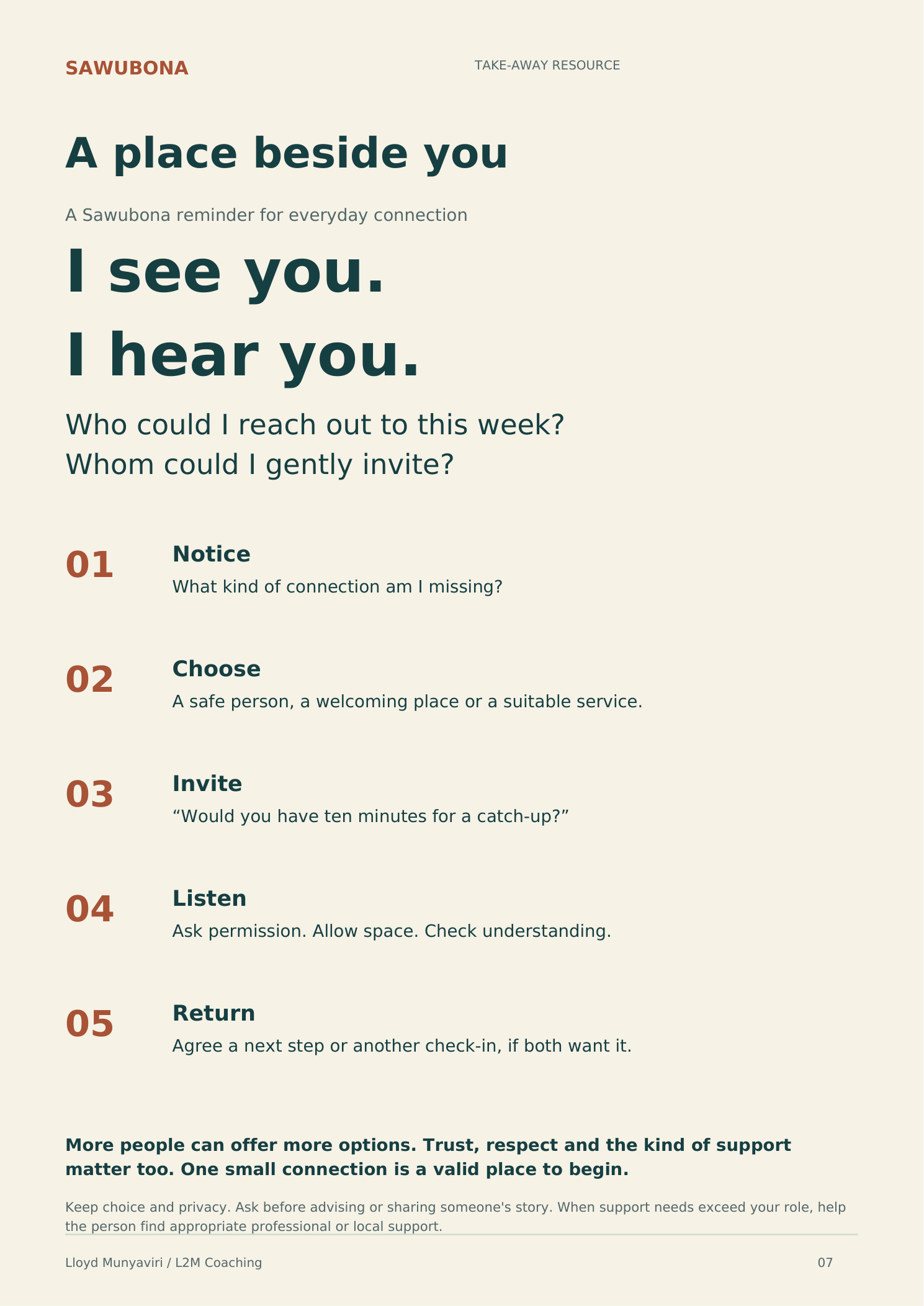
What kind of connection am I missing?
A safe person, a welcoming place or a suitable service.
“Would you have ten minutes for a catch-up?”
Ask permission. Allow space. Check understanding.
Agree a next step or another check-in, if both want it.
Start with the facilitator guide, present the lesson slides and print the workbook. The workbook includes the support map, listening checklist, connection plan and a one-page take-away.
PowerPoint · 24 slides
Present the visual lesson and use the speaker notes for prompts, timings and activity instructions.
Download PowerPointPDF · 24 slides
Read or share the complete visual presentation without PowerPoint.
Download slides PDFPDF · 13 pages
Start here for preparation, the 90-minute running order, facilitation scripts, adaptations and source notes.
Download facilitator guidePDF · 7 pages
Print six pages of private reflection, support mapping, listening practice and planning, plus a one-page take-away.
Download workbookPNG image
Keep the Notice, Choose, Invite, Listen and Return reminders on your phone or share the image.
Download reminder imageKeep personal maps private. Ask before giving advice, sharing someone else’s story or arranging follow-up. There is no required number of friends and no pressure to reconnect with someone who feels unsafe.
This is an educational coaching resource. The private 0–10 check-in supports reflection and is not a diagnostic measure. The lesson does not provide counselling or crisis care. Facilitators should explain confidentiality limits and prepare appropriate local support and safeguarding arrangements.
The activities, fictional case, wording and layouts are original to this Sawubona pack. The supplied Joshua Freedman / Six Seconds community resources inspired the theme. Their artwork and text are not reproduced. Full source notes appear in the facilitator guide.
Background sources: WHO social connection Q&A, WHO Commission report and Gallup workplace friendship research. These organisations do not endorse this lesson.
Explore all Sawubona resources