This blog report draws primarily on Gallup's State of the Global Workplace 2026, Six Seconds' The Business Case for Emotional Intelligence 2026, and Six Seconds' review of more than 50 emotional-intelligence case studies.
As I reviewed the Africa-related evidence, one statistic kept stopping me:
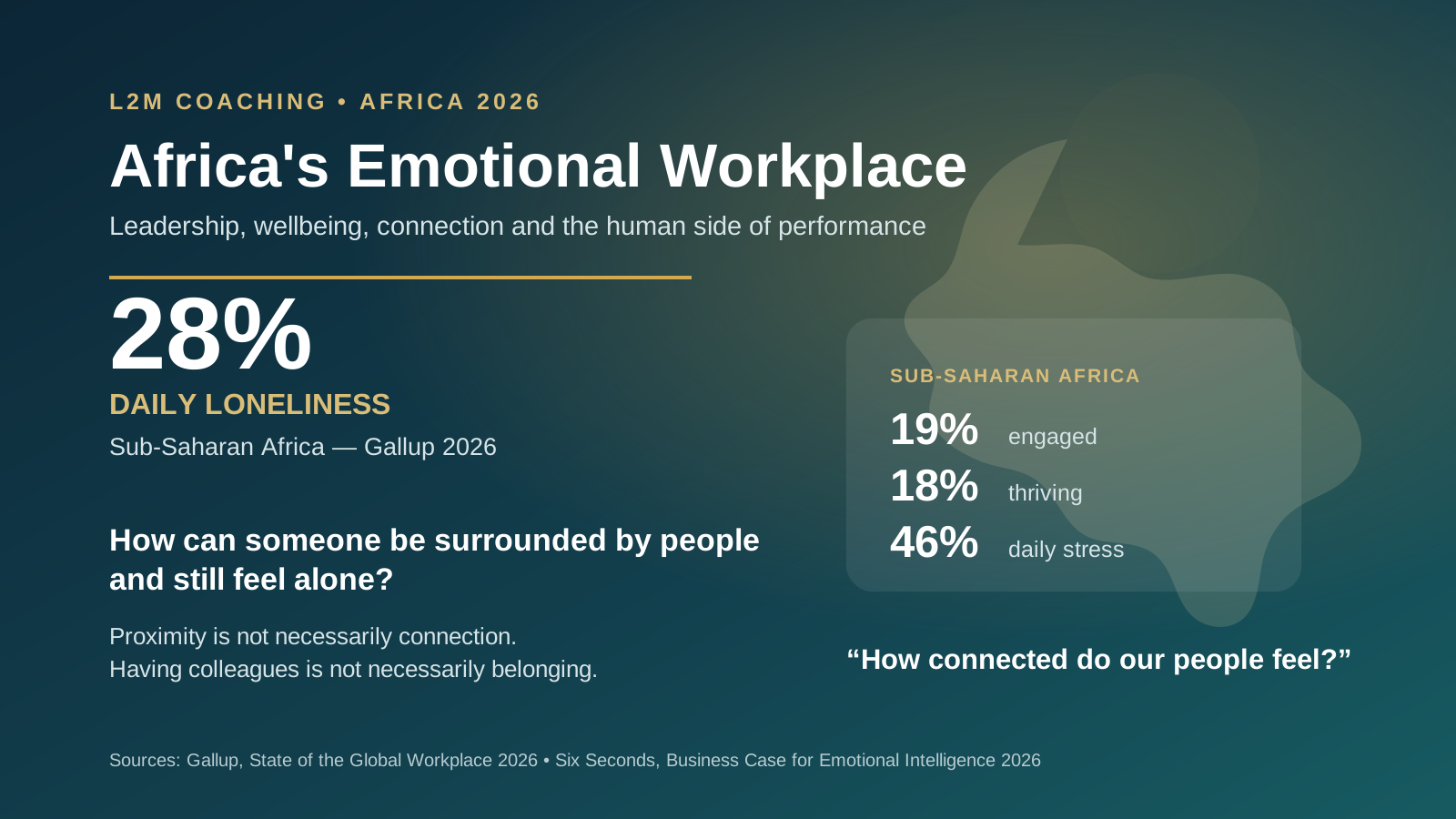
28% of employees in Sub-Saharan Africa reported experiencing loneliness during the previous day.
That number deserves more than a passing mention. It raises a fundamental leadership question for workplaces and societies shaped by ideas such as Ubuntu, community, extended family and collective identity:
How can someone be surrounded by people and still feel alone?
Perhaps because proximity is not necessarily connection.
Having colleagues is not necessarily belonging.
Being in a family is not necessarily being understood.
Being part of a community does not automatically mean that someone has somewhere they feel safe enough to say:
“This is what I am carrying.”
And being surrounded by people certainly does not guarantee that someone feels seen or heard.
This is also where the African idea of Sawubona — “I see you” becomes more than a greeting. For me, it offers a leadership challenge: can our workplaces become places where people are not merely present, but genuinely noticed, heard and treated as human beings?
Executive summary
Gallup's 2026 Sub-Saharan Africa data paints a complex picture. Workplace engagement is close to the global average, yet life evaluation and emotional strain tell a much more difficult story.
- 19% of employees are engaged.
- 18% are thriving, compared with 34% globally.
- 73% are classified as struggling in their life evaluation.
- 46% report a lot of daily stress.
- 28% report daily sadness.
- 28% report daily loneliness.
- 25% report daily anger.
My central conclusion is this:
Africa's workplace challenge may not simply be a skills gap. It may also be a connection, wellbeing and leadership-capability gap.
That does not mean emotional intelligence can solve structural challenges such as unemployment, poverty, infrastructure, health-system pressures or economic insecurity. It means leaders cannot sustainably address performance without paying attention to the emotional and relational conditions in which performance happens.
It also gives greater urgency to the principle at the heart of Sawubona: before we rush to fix, advise or judge, we first need to see the person, hear the person and recognise that they matter.
A note on the data
The figures in this report are Sub-Saharan Africa figures unless otherwise stated. Gallup groups North Africa within its Middle East and North Africa region, so it would be misleading to combine the two regional datasets and present them as a single Africa-wide average.
The Six Seconds findings used here are a mixture of global research and specific organisational case evidence. Where evidence is global, I describe it as global rather than presenting it as Africa-specific.
Sawubona is not a Gallup or Six Seconds programme. In this report I use it as an L2M Coaching listening and human-connection lens that helps translate the evidence into practical leadership behaviour.
The central finding: 28% loneliness
The loneliness figure matters because it exposes something that conventional performance dashboards can miss.
An employee can be physically present and emotionally disconnected.
A team can meet every day and still lack trust.
A manager can speak to an employee every morning without ever having a meaningful conversation.
A person can be part of a family, a church, a community group and a workplace — and still feel that nobody really knows what they are carrying.
For me, this creates a second question that belongs alongside the traditional employee-engagement question.
Not only: “How engaged are our people?”
But also: “How connected do our people feel?”
Do people have relationships built on trust rather than transaction?
Do they feel they belong?
Do they have someone they can approach before a small difficulty becomes a major problem?
Can they say “I am struggling” without fearing judgement or career consequences?
Do managers know how to listen without immediately fixing, advising or dismissing?
These are not only wellbeing questions. They are questions about leadership, culture, retention and sustainable performance.
Sawubona: from being around people to being seen by people
Sawubona is often translated as “I see you.” In the context of this report, that phrase captures something the loneliness statistic forces us to confront.
People do not only need contact. They need meaningful human connection.
They need moments in which another person is sufficiently present to notice, listen and understand before trying to solve.
For leaders, that can mean moving from:
- asking “Are you okay?” and moving on before hearing the answer;
- to creating enough space for a person to say what is really happening;
- from immediately advising;
- to asking what support would actually be helpful;
- from seeing only the employee role;
- to remembering the human being performing that role.
This does not mean every leader becomes a counsellor. It means leaders become better at human presence, empathic listening, appropriate boundaries and knowing when to signpost or refer for specialist support.
Sawubona asks: before I manage the task, have I really seen the person?
You can learn more about the L2M Coaching Sawubona programme here.
Engagement is not the same as thriving
Gallup reports that 19% of employees in Sub-Saharan Africa are engaged, compared with 20% globally.
On engagement alone, the region therefore sits close to the global picture.
But only 18% are thriving, compared with 34% globally. Gallup also reports that 73% are struggling.
This gap changes the conversation.
Someone can be engaged with their work while still struggling in their life.
They can deliver results while carrying significant financial, family, health or emotional pressures.
They can attend every meeting and still feel invisible.
They can remain with an organisation without feeling that they belong there.
If leaders measure only productivity, attendance, retention and engagement, they may only be seeing part of the person.
The emotional workplace is already here
In Sub-Saharan Africa, Gallup reports that 46% of employees experienced a lot of stress during the previous day, 28% sadness, 28% loneliness and 25% anger.
Those emotions do not disappear when somebody arrives at work.
People bring their lives into the workplace: responsibilities, hopes, worries, relationships, disappointments and uncertainty.
This does not mean managers should become therapists. It does mean that modern managers need enough emotional intelligence to notice changes, listen effectively, create trust, respond appropriately and recognise when specialist support is needed.
This is closely aligned with the Sawubona principle of listening without rushing to fix: creating a human moment in which somebody can speak, be heard, and retain dignity.
Why emotional intelligence belongs in the leadership conversation
Emotional intelligence is sometimes still placed under the heading of “soft skills”. I think that description increasingly understates what is involved.
There is nothing particularly soft about:
- remaining composed under pressure;
- listening when you strongly disagree;
- recognising emotion before it becomes conflict;
- challenging performance without destroying dignity;
- building trust during uncertainty;
- making difficult decisions while considering both facts and people;
- helping a team navigate change without losing connection.
Six Seconds' 2026 business case brings together research linking emotional intelligence with leadership judgement, engagement, trust, retention, customer experience and performance. It also makes an important practical point: emotional intelligence is learnable, measurable and developable.
Africa-specific evidence: Kenya
One finding in Six Seconds' 2026 review of more than 50 case studies is particularly relevant to this conversation.
The review reports that PTS Africa found emotional intelligence predicted more than 35% of leadership effectiveness among women CEOs and board members in Kenya.
This is a specific population and should not be generalised to all African leaders. But it gives the African EQ conversation an important regional proof point: emotional intelligence can have a measurable relationship with leadership effectiveness in an African context.
It also shows why Africa needs more locally grounded research across countries, industries, genders, ages and levels of leadership.
Managers are a critical leverage point
Gallup's Sub-Saharan Africa data shows that managers are more engaged than individual contributors. But managers themselves continue to carry substantial emotional strain.
Consider what we now expect of a manager:
- deliver targets;
- manage conflict;
- motivate people;
- support wellbeing;
- coach performance;
- communicate strategy;
- implement new systems;
- lead AI and digital change.
And then we often give them little meaningful development in how to lead people.
Who is developing the manager?
If the manager is a key driver of trust, engagement and change adoption, then developing managers cannot be treated as an optional HR activity. It is part of organisational infrastructure.
Managers also need practical ways of responding when performance conversations reveal something deeper. A Sawubona-informed manager does not need to have all the answers. They need to know how to notice, ask, listen, respect boundaries and connect people with the right support when necessary.
AI makes the human side of leadership more important
Across Africa, organisations are investing in AI, automation and digital capability. That investment matters.
But Gallup's 2026 report makes a wider global argument that is highly relevant: technology adoption depends heavily on management and organisational readiness.
As machines become better at machine work, people need to become better at the capabilities that make human collaboration work:
- judgement;
- adaptability;
- empathy;
- trust;
- communication;
- relationship building;
- emotional intelligence.
Technology implementation is therefore not only a technical project. It is also a human change process.
Ubuntu, Sawubona and the modern African workplace
Ubuntu is often expressed through the idea:
“I am because we are.”
Sawubona adds another deeply human question to that idea:
Do I truly see the people who make up the “we”?
We can celebrate community culturally while still experiencing disconnection individually.
We can work in teams without truly knowing one another.
We can communicate continuously through technology while having fewer conversations where somebody genuinely feels heard.
So perhaps Ubuntu cannot only be something we remember from the past. It has to be something we practise in the present.
And Sawubona cannot simply be a greeting. It can become a leadership practice: slow down, notice, listen, understand, and respond with dignity.
Not simply:
“We work together.”
But:
“I see you. I hear you. You matter.”
Six practical priorities for African organisations
1. Measure beyond engagement
Track trust, wellbeing, belonging, manager capability and psychological safety alongside traditional engagement and performance measures.
2. Develop managers as people leaders
Make coaching, listening, conflict management, emotional regulation and relationship building part of core management capability.
3. Create structured opportunities for people to be heard
Not every conversation needs to become therapy. But people do need psychologically safe spaces for meaningful conversation, supported by clear boundaries and referral routes when specialist help is required. A Sawubona-informed listening approach can help organisations create those spaces without confusing listening with counselling.
4. Integrate EQ into transformation and AI programmes
Technical training alone is not enough. Change also requires trust, communication, emotional sense-making and good people leadership.
5. Localise the response
Africa is not a single workforce. Country, culture, sector, age, gender and job level all matter. Organisations should understand their own context before designing interventions.
6. Measure impact before scaling
Start with a defined organisational problem. Establish a baseline. Develop capability. Coach application. Measure again. The strongest Six Seconds cases repeatedly use this measure-develop-measure pattern.
What this means for Sawubona
The data gives important context to the thinking behind Sawubona.
Sawubona — “I see you” — is not about turning everyday listeners into counsellors. It is about creating structured human spaces where people can be heard with empathy, dignity and appropriate boundaries.
In a region where 28% of employees report loneliness, the ability to listen well is not insignificant.
Sometimes people do not need an immediate answer.
They need a place where they can say:
“This is what I am carrying.”
And for another person to be present enough to respond:
“I see you. I hear you. You matter.”
For L2M Coaching, Sawubona is a practical response to that human need for connection: listening first, asking rather than assuming, respecting boundaries, and recognising when a person needs support beyond the conversation.
Explore the Sawubona programme and its approach to human connection.
Conclusion: from presence to connection
Africa absolutely needs technical skills, digital capability, stronger systems, infrastructure and operational excellence.
But this evidence suggests that our future-of-work conversation needs to become wider.
Africa's workplace challenge may not simply be a skills gap. It may also be a connection, wellbeing and leadership-capability gap.
That is why the 28% loneliness figure matters.
It asks us to look beyond whether people are physically present and ask whether they are genuinely connected.
It asks us to look beyond whether people are performing and ask whether they are thriving.
It asks us to look beyond whether people work together and ask whether they trust one another.
And it asks leaders to pay attention to the human beings who make performance possible.
Technology changes work.
Systems enable work.
But people still make work happen.
Perhaps the two questions African leaders can now ask together are:
How connected do the people in our organisation really feel?
And are we creating enough Sawubona moments — moments where people genuinely feel seen, heard and valued?
Sources and evidence base
This blog report is an L2M Coaching interpretation of evidence from:
- Gallup (2026), State of the Global Workplace: The Human Side of the AI Revolution — particularly the Sub-Saharan Africa regional section and country-level data.
- Six Seconds (2026), The Business Case for Emotional Intelligence: Understanding How Emotional Intelligence Fuels Engagement, Retention and Performance.
- Joshua Freedman / Six Seconds (2026), Emotional Intelligence at Work: 10 Actionable Insights for HR Leaders from 50 Case Studies, including the PTS Africa/Kenya finding.
The Gallup statistics in this report refer to Sub-Saharan Africa unless otherwise stated. North Africa is reported by Gallup within its MENA region and has not been merged into an invented Africa-wide average. Global Six Seconds findings have not been relabelled as African findings. Sawubona is presented here as an L2M Coaching application and interpretation of the connection challenge; it is not a Gallup or Six Seconds intervention.
About the author: Lloyd Munyaviri is a leadership and performance coach, organisational consultant and founder of L2M Coaching. His work combines operational leadership, emotional intelligence, coaching and people-centred systems to help organisations build stronger leaders and sustainable performance.