As part of the Monthly Connect Better Podcast Series we run at L2MCoaching (everyone is invited) once a month, a number of topics for discussion are suggested and this one is a popular request and I hope to do it justice: In relationships, one of the hardest conversations to have is the conversation about rejection, intimacy, emotional needs and unmet expectations. It is a sensitive subject because it can easily be misunderstood. When a partner says “no”, that “no” must be respected. No one...
As part of the Monthly Connect Better Podcast Series we run at L2MCoaching (everyone is invited) once a month, a number of topics for discussion are suggested and this one is a popular request and I hope to do it justice:
In relationships, one of the hardest conversations to have is the conversation about rejection, intimacy, emotional needs and unmet expectations.
It is a sensitive subject because it can easily be misunderstood.
When a partner says “no”, that “no” must be respected.
No one should ever feel pressured, guilted, manipulated or forced into saying “yes” when they do not want to. Respect, consent, emotional safety and personal boundaries are essential in any healthy relationship.
But there is another side of the conversation that is rarely spoken about honestly.
What happens when one partner, often the man, hears “no” repeatedly, over a long period of time, without explanation, reassurance, affection or meaningful conversation?
Because sometimes, after a while, the man may no longer simply hear:
“Not tonight.”
He may begin to hear:
“You are unwanted.”
“You are undesirable.”
“You are tolerated, not desired.”
“Your needs do not matter.”
“You are emotionally alone in this relationship.”
And that can slowly do damage.
Not because he is entitled to anything.
Not because his partner owes him intimacy.
But because repeated rejection without communication can begin to erode emotional connection, confidence, vulnerability and self-worth.
Many men will never say this out loud.
Instead, they may withdraw.
They may stop initiating.
They may become quieter.
They may bury themselves in work.
They may become resentful.
They may start seeking validation elsewhere.
Or they may simply begin to disappear emotionally from the relationship.
And often, by the time this becomes visible, the distance has already grown.
But this is not only about men.
This is about the health of the relationship.
Because the partner saying “no” may also be carrying something real.
They may be tired.
They may feel emotionally unsupported.
They may feel unseen.
They may be carrying stress, resentment, hormones, trauma, pressure, mental load, physical exhaustion or unresolved hurt.
Sometimes “no” is not rejection even though it feel like it
Sometimes “no” means:
“I do not feel emotionally connected.”
“I am exhausted.”
“I do not feel safe.”
“I need tenderness before intimacy.”
“I feel taken for granted.”
“I need us to talk.”
“I am struggling, but I do not know how to say it.”
This is why the real issue is not simply the word “no”.
The real issue is what happens after the “no”. Do you revist the conversation and give an explanation or just bury your head in the sand in the hope that it all goes away?
Is there reassurance?
Is there tenderness?
Is there conversation?
Is there curiosity?
Is there repair?
Is there emotional honesty?
Or does silence take over?
A healthy relationship is not built on one person always saying yes.
But it is also not built on one person repeatedly feeling rejected and the other repeatedly feeling pressured.
Both are damaging.
Constant pressure damages trust.
Constant rejection without explanation damages connection.
The question is not, “How many nos are too many?”
The deeper question is:
“What is this pattern telling us about the state of our relationship?”
Because when “no” becomes frequent, unexplained, and emotionally cold, it stops being just a moment. It becomes a message.
And when one partner feels they cannot say “no” safely, that also becomes a message.
Both messages matter.
That is why couples need to talk about intimacy before resentment becomes the loudest voice in the room.
They need to talk about:
What does “no” really mean for you?
What do you need in order to feel close?
What makes you feel wanted?
What makes you feel pressured?
What helps you feel emotionally safe?
What has changed between us?
What are we not saying?
How can we protect both respect and connection?
These are not easy conversations.
But they are necessary ones.
Because love does not survive on assumption.
Connection does not grow through silence.
And intimacy cannot be healthy if one person feels obligated while the other feels unwanted.
The goal is not to count how many times someone says “no”.
The goal is to make sure neither partner slowly disappears emotionally inside the relationship.
Healthy love requires respect.
Healthy love requires consent.
Healthy love requires honesty.
Healthy love requires reassurance.
Healthy love requires both people to feel wanted, valued, safe and heard.
So maybe the conversation should not begin with blame.
Maybe it should begin with courage.
Not:
“Why do you always say no?”
But:
“I miss feeling close to you.”
“I want to understand what is happening between us.”
“I do not want either of us to feel pressured, rejected or alone.”
“How do we find our way back to each other?”
Because sometimes the most loving thing a couple can do is stop pretending everything is fine and finally have the conversation that could save the connection.
Choose understanding.Choose respect.Choose each other.
Please follow us for more or to read about more of our work please check out
Reading creates awareness. Coaching creates lasting change. Book a free 30-minute conversation to explore what this could look like in your specific situation.
Discussion
No comments yet — be the first to share your thoughts.
By Lloyd Munyaviri | L2MCoaching After Blaming Foreigners, Who Do We Blame When AI Takes the Jobs? For years, in many societies, when people have felt economically squeezed, one of the easiest narratives has been: “foreigners are taking our jobs.” We have heard it in the UK. We have heard it in South Africa. We have heard it in communities where people are struggling with unemployment, poor wages, insecure work, rising costs, stretched public services and a deep sense that life is becoming...
Why knowledge alone is not enough and what we need to learn instead. We’ve been conditioned to believe something powerful: “Education is the answer.” Say it enough times, and it becomes truth. Build systems around it, and it becomes policy.Repeat it to selves and our children and it becomes belief. But let’s pause for a moment and ask a question that rarely gets asked: Education… then what? Because if education truly was the answer, we wouldn’t have so many educated people feeling stuck,...
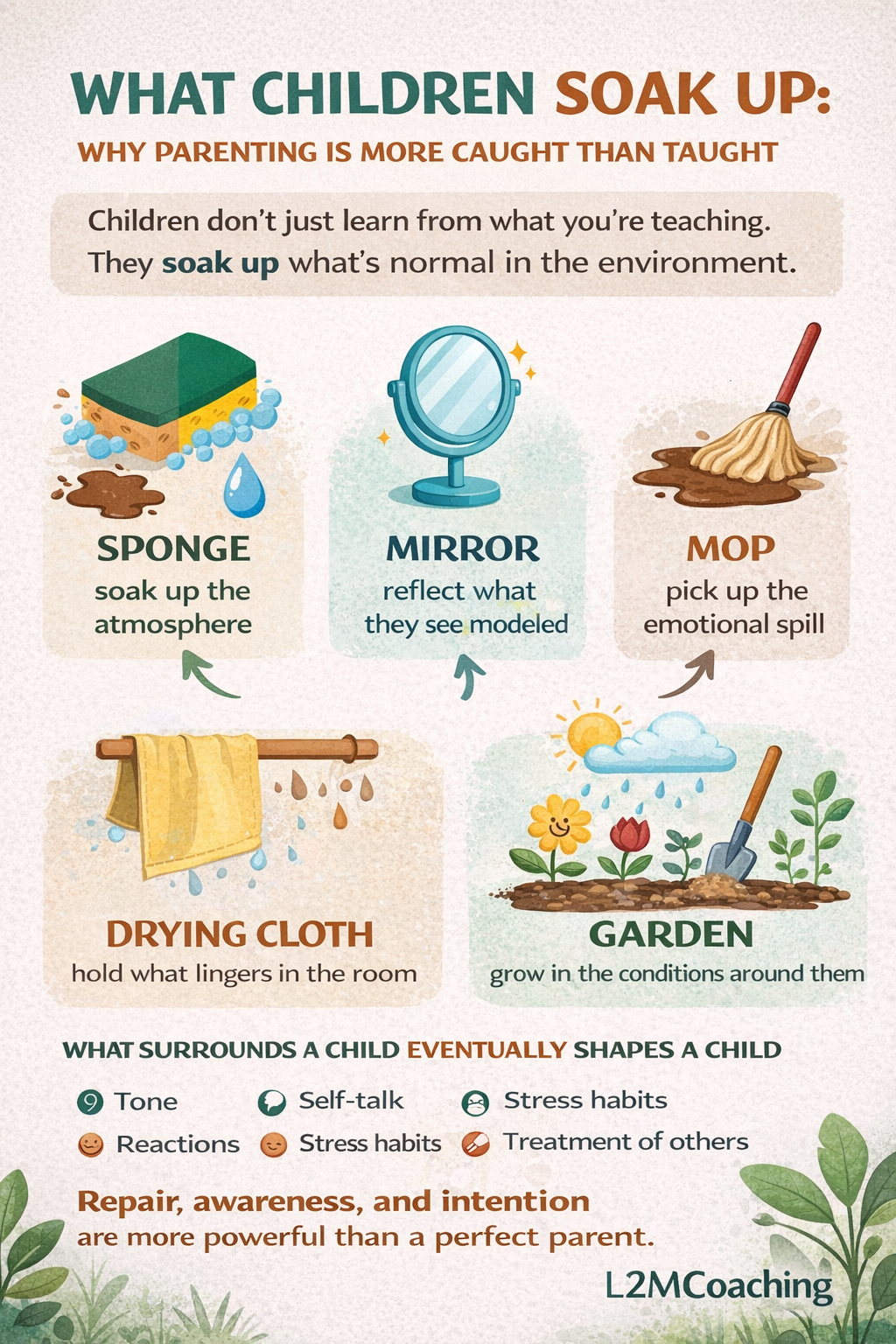
Children learn from more than words. They learn from tone, habits, reactions, emotional safety, and what becomes normal around them. As parents, guardians and carers, we often focus on what we need to say to our children. We remind them to be kind, calm, honest, respectful and confident. Those messages matter, but children are learning from far more than direct instruction. They are also learning from the environment they grow up in. Children absorb more than advice. They take in the...