First They Blamed Foreigners for Taking Jobs. Now AI Is Coming for Work. Who Do We Blame Next?
LM
Lloyd Munyaviri
EMCC Accredited Coach
By Lloyd Munyaviri | L2MCoaching After Blaming Foreigners, Who Do We Blame When AI Takes the Jobs? For years, in many societies, when people have felt economically squeezed, one of the easiest narratives has been: “foreigners are taking our jobs.” We have heard it in the UK. We have heard it in South Africa. We have heard it in communities where people are struggling with unemployment, poor wages, insecure work, rising costs, stretched public services and a deep sense that life is becoming...
By Lloyd Munyaviri | L2MCoaching
After Blaming Foreigners, Who Do We Blame When AI Takes the Jobs?
For years, in many societies, when people have felt economically squeezed, one of the easiest narratives has been: “foreigners are taking our jobs.”
We have heard it in the UK.
We have heard it in South Africa.
We have heard it in communities where people are struggling with unemployment, poor wages, insecure work, rising costs, stretched public services and a deep sense that life is becoming harder and now, another force has entered the workplace conversation: artificial intelligence.
AI is no longer a distant idea. It is already changing how work is done. It is already reshaping recruitment, administration, customer service, legal work, accounting, marketing, project management, coding, design, logistics, education and many other areas of professional life.
The uncomfortable truth is this: if jobs are increasingly being changed, reduced or redesigned by AI, then the old blame game starts to fall apart.
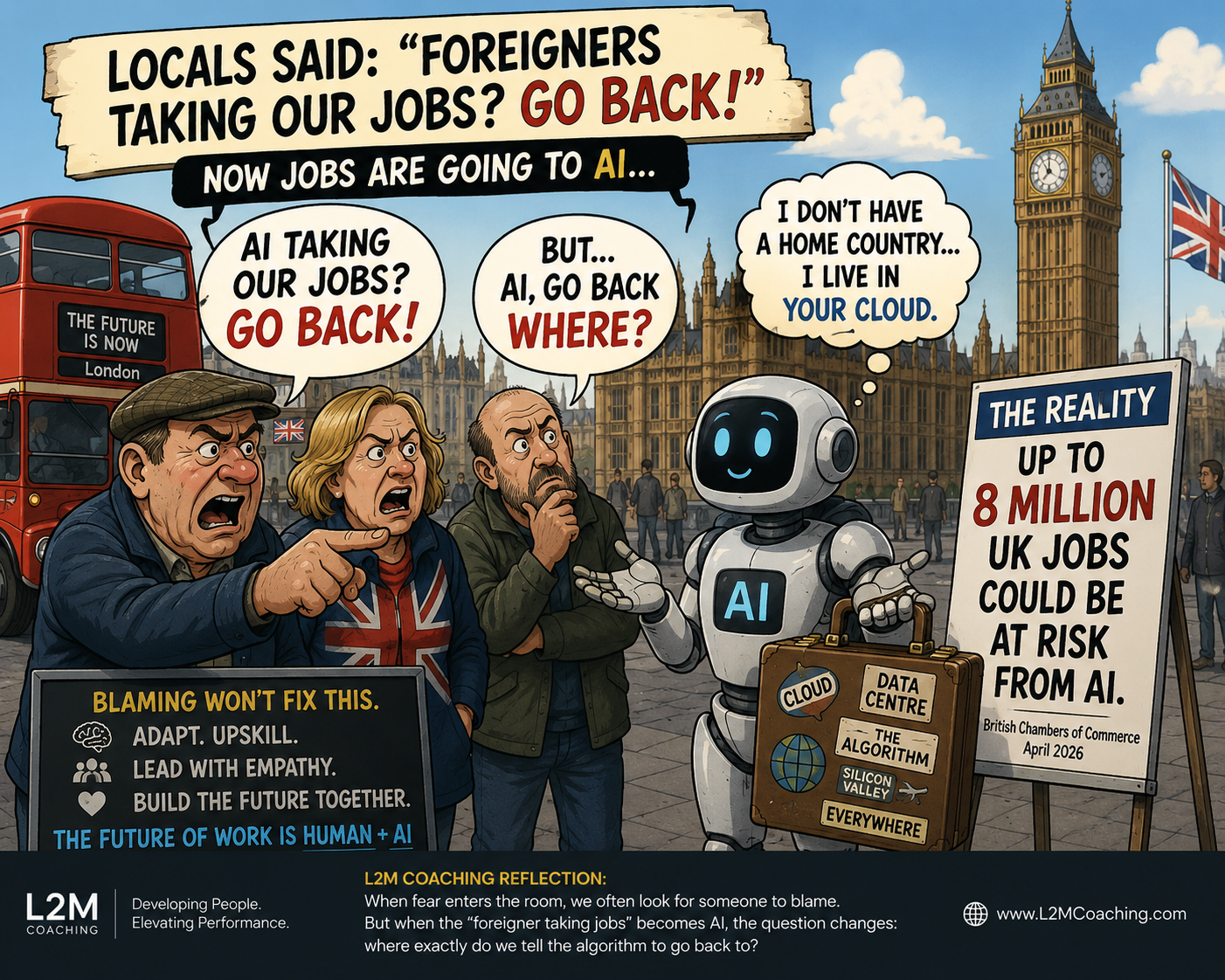
Because when the perceived “threat” is no longer a person from another country, but a piece of technology, where exactly do we tell AI to “go back” to?
That is the question we now have to sit with.
AI Is Not Coming. AI Is Already Here.
The British Chambers of Commerce recently warned that Britain’s workforce is not ready for what is coming. Their article highlighted that 54% of British firms are now using AI and although most have not yet reduced headcount, the deeper concern is what happens as AI moves from basic tools into more advanced, bespoke business integration.
This is where the real shift begins.
It is not just about ChatGPT helping someone write an email. It is about AI being built into business systems, decision-making processes, customer journeys, finance tasks, HR systems, operational planning and knowledge work.
The World Economic Forum has projected that by 2030, global job disruption could affect 22% of jobs, with 170 million new roles created and 92 million displaced. That is not a small workplace adjustment. That is a global reshaping of work.
At the same time, PwC’s 2025 Global AI Jobs Barometer argues that AI can make people more valuable, not less, especially where people learn how to use it well. Their research suggests that AI-related skills are linked to higher wages and productivity growth.
So the story is not simply “AI is bad.”
AI can absolutely be a force for good. It can improve productivity, reduce repetitive work, support decision-making, increase access to knowledge, improve safety, speed up research, and help people do more meaningful work.
But we must also be honest.
AI will reduce the need for some technical tasks to be done by humans. In some areas, fewer people may be needed to produce the same output. Entry-level roles may become harder to access. Certain administrative, analytical and professional tasks may be automated or absorbed into AI-powered systems.
That means the challenge is not just technological.
It is emotional, social, ethical and leadership-based.
The Blame Game Will Not Save Us
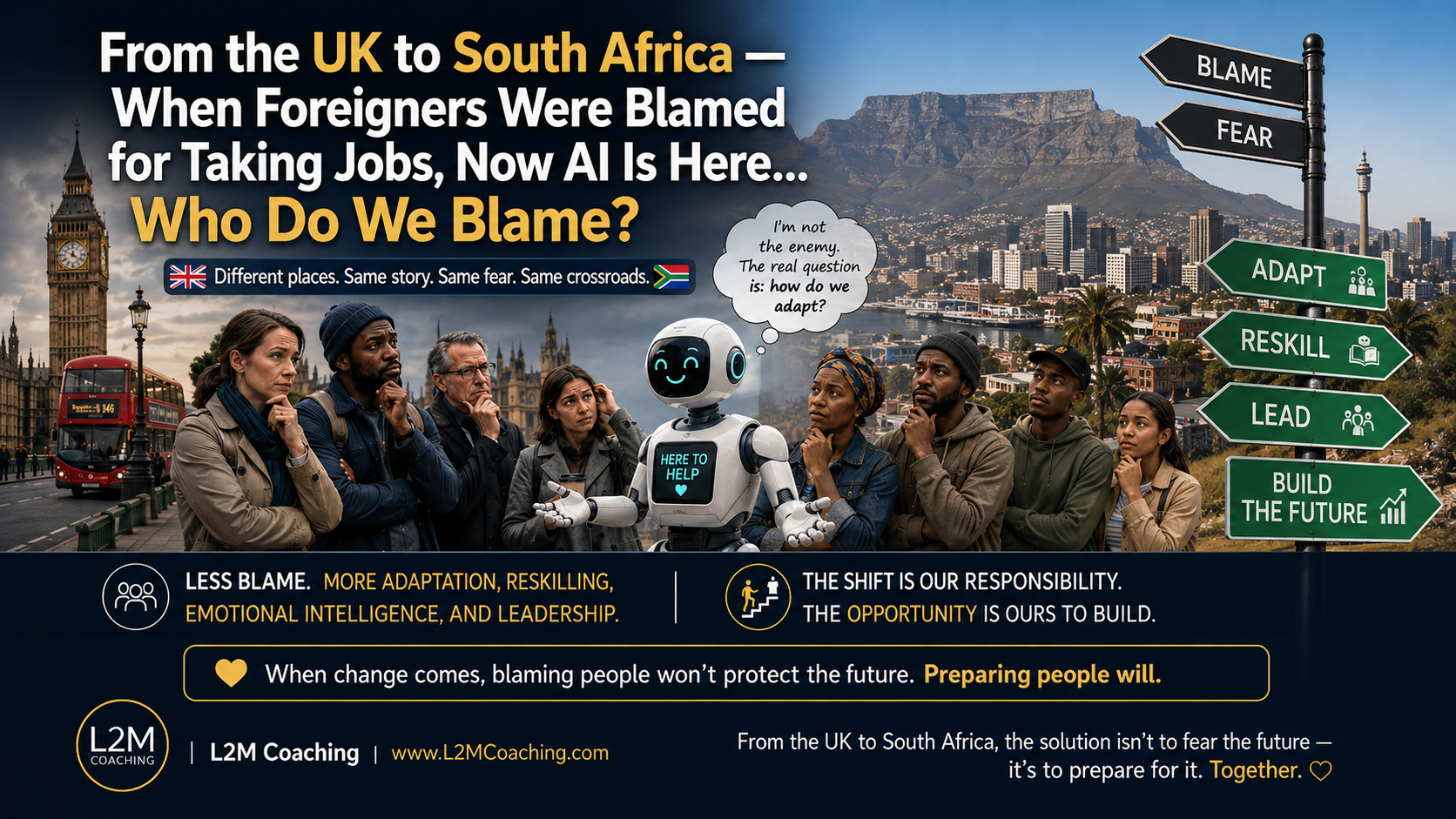
In the UK, some people have long blamed immigrants for pressure on jobs, housing, wages and public services.
In South Africa, foreign nationals have also been blamed for unemployment, crime, poor service delivery and economic hardship. This has not only created division, but in some cases has contributed to dangerous xenophobic violence and the dehumanisation of people who are often also trying to survive.
But blaming foreigners has always been too simple.
It avoids the harder questions.
Are governments investing properly in skills?
Are education systems preparing people for the real economy?
Are businesses developing their people or simply extracting performance until they are no longer useful?
Are communities being told the truth about economic change?
Are leaders brave enough to talk about productivity, inequality, technology, wages, training and opportunity?
Are individuals taking responsibility for lifelong learning?
When society blames the foreigner, it often avoids looking at the system.
Now AI exposes that avoidance.
Because AI is not a migrant worker.
AI is not crossing a border looking for a better life.
AI is not sending money home to feed a family.
AI is not occupying a house, using a hospital bed or standing in a job queue.
AI is a tool created, owned, deployed and monetised by people, companies and systems.
So if jobs are lost or redesigned because of AI, the real question is not, “Who do we hate now?”
The real question is, “Who is responsible for preparing people for this change?”
We Need Less Scapegoating and More Skill-Building
The future will not belong only to the most technical people.
In fact, one of the biggest shifts may be that some technical tasks become easier to automate. Coding, report writing, basic analysis, document drafting, scheduling, simple design, data processing and routine knowledge work are already being supported by AI tools.
That means people will need more than technical ability.
They will need judgement.
They will need adaptability.
They will need communication.
They will need emotional intelligence.
They will need creativity.
They will need ethical decision-making.
They will need the ability to work with people, not just tools.
They will need to ask better questions, interpret better answers, challenge poor assumptions, build trust, manage change and lead through uncertainty.
This is where emotional intelligence becomes central.
When people feel threatened, they often look for someone to blame. Fear can become anger. Anger can become resentment. Resentment can become division.
But emotional intelligence invites us to pause and ask: what is this fear trying to tell us?
Maybe it is telling us that people do not feel prepared.
Maybe it is telling us that workers feel disposable.
Maybe it is telling us that leaders have failed to communicate clearly.
Maybe it is telling us that people are worried about feeding their families.
Maybe it is telling us that society has not created enough fair pathways into meaningful work.
The emotion is real. The fear is real. The anxiety is real.
But the target of the blame may be wrong.
The Responsibility Sits With All of Us
This is not about telling people, “Just adapt,” while ignoring the real pain of job loss.
That would be unfair. Some people will be affected more than others. Some industries will change faster than others. Some workers will have access to training, networks and opportunities, while others will be left behind unless leaders act intentionally.
So responsibility must be shared. Governments need to invest in serious reskilling, education reform, digital inclusion and economic planning.
Businesses need to stop treating AI only as a cost-cutting tool and start asking how it can be used to grow capability, improve services and create new value.
Leaders need to communicate honestly and develop people before the crisis arrives.
Communities need to reject scapegoating and create spaces for practical learning, mentoring and support.
Individuals need to stay curious, keep learning and avoid the temptation to wait until change becomes an emergency.
The future of work cannot be left only to technology companies. It must be shaped by human values.
The Real Question Is Not “Who Took My Job?”
The better question is: what is happening to work, and how do we prepare ourselves and our communities?
If we only ask, “Who took my job?” we will keep looking for enemies.
If we ask, “What skills do I now need?” we create movement.
If we ask, “How do we protect people through change?” we create responsibility.
If we ask, “How do we use AI without losing our humanity?” we create leadership.
And if we ask, “How do we make sure ordinary people benefit from this technology?” we create justice.
The danger is not only that AI may replace some jobs.
The bigger danger is that we repeat the same old pattern: fear, blame, division, delay and then panic.
We have seen this before.
Blame the foreigner.
Blame the migrant.
Blame the outsider.
Blame the person who looks different, speaks differently, or came from somewhere else.
But now AI forces us to face the truth: blaming people was never a strategy.
It was a distraction.
From Blame to Readiness
The societies that will do well in the AI age are not the ones that shout the loudest about who does not belong.
They will be the ones that prepare their people.
They will be the ones that build skills.
They will be the ones that protect dignity.
They will be the ones that combine technology with humanity.
They will be the ones that understand that emotional intelligence, adaptability and lifelong learning are no longer soft skills. They are survival skills.
So, after blaming foreigners, who do we blame when AI changes the job market?
Maybe the better answer is: we stop blaming and start building.
Because AI does not need hatred.
People need hope.
People need skills.
People need leadership.
People need honest conversations.
And above all, people need societies that are brave enough to prepare for the future instead of looking for someone to punish for it.
Lloyd MunyaviriL2M CoachingHelping leaders, professionals and communities become smarter with emotions, stronger through change, and more human in how they lead.
Reading creates awareness. Coaching creates lasting change. Book a free 30-minute conversation to explore what this could look like in your specific situation.
Discussion
No comments yet — be the first to share your thoughts.
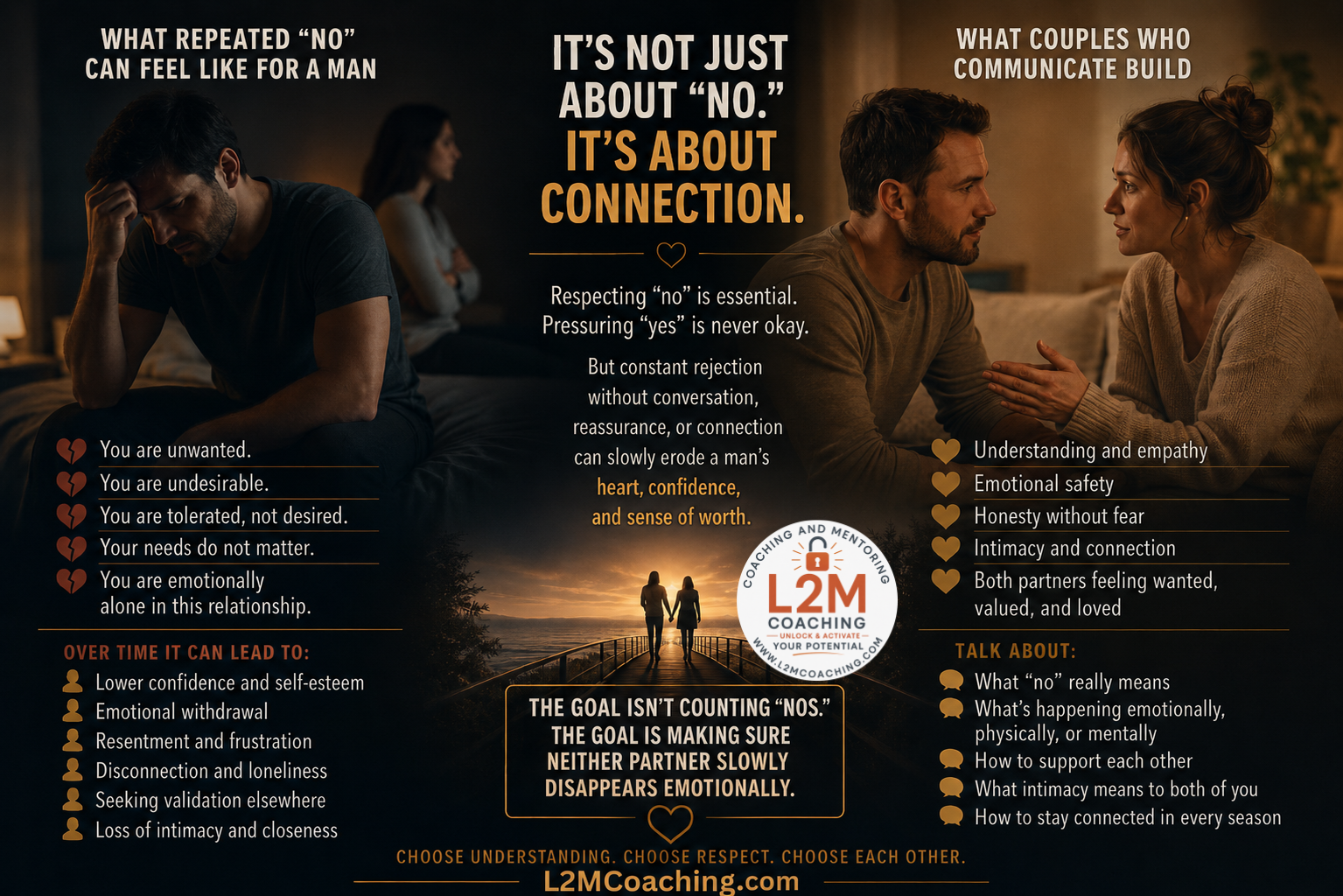
As part of the Monthly Connect Better Podcast Series we run at L2MCoaching (everyone is invited) once a month, a number of topics for discussion are suggested and this one is a popular request and I hope to do it justice: In relationships, one of the hardest conversations to have is the conversation about rejection, intimacy, emotional needs and unmet expectations. It is a sensitive subject because it can easily be misunderstood. When a partner says “no”, that “no” must be respected. No one...
Why knowledge alone is not enough and what we need to learn instead. We’ve been conditioned to believe something powerful: “Education is the answer.” Say it enough times, and it becomes truth. Build systems around it, and it becomes policy.Repeat it to selves and our children and it becomes belief. But let’s pause for a moment and ask a question that rarely gets asked: Education… then what? Because if education truly was the answer, we wouldn’t have so many educated people feeling stuck,...
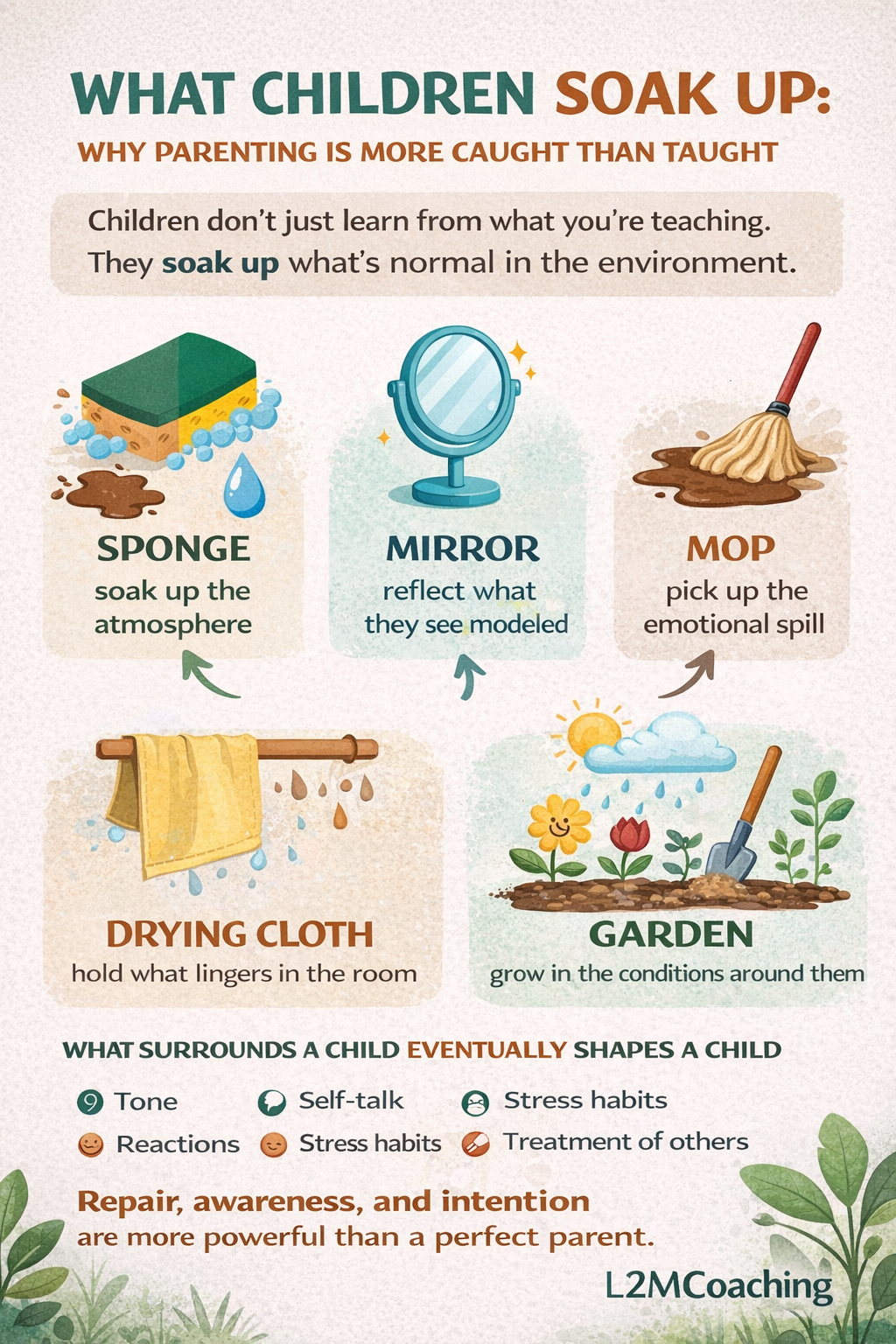
Children learn from more than words. They learn from tone, habits, reactions, emotional safety, and what becomes normal around them. As parents, guardians and carers, we often focus on what we need to say to our children. We remind them to be kind, calm, honest, respectful and confident. Those messages matter, but children are learning from far more than direct instruction. They are also learning from the environment they grow up in. Children absorb more than advice. They take in the...