When it comes to your emotions, Who Holds the Remote control?
LM
Lloyd Munyaviri
EMCC Accredited Coach
Emotional Responsibility, Boundaries, and the Power to Change Your Relationships “They made me angry.” “They triggered me.” “They always push my buttons.” We say these phrases so casually that we rarely stop to question them. But inside those everyday statements is something profound. When we say someone made us angry, we are quietly handing them control over our emotional world. We are suggesting that our internal state lives in someone else’s hands. And that leads to one powerful question:...
Emotional Responsibility, Boundaries, and the Power to Change Your Relationships
“They made me angry.”
“They triggered me.”
“They always push my buttons.”
We say these phrases so casually that we rarely stop to question them.
But inside those everyday statements is something profound.
When we say someone made us angry, we are quietly handing them control over our emotional world. We are suggesting that our internal state lives in someone else’s hands.
And that leads to one powerful question:
Who is holding the remote control to your life?
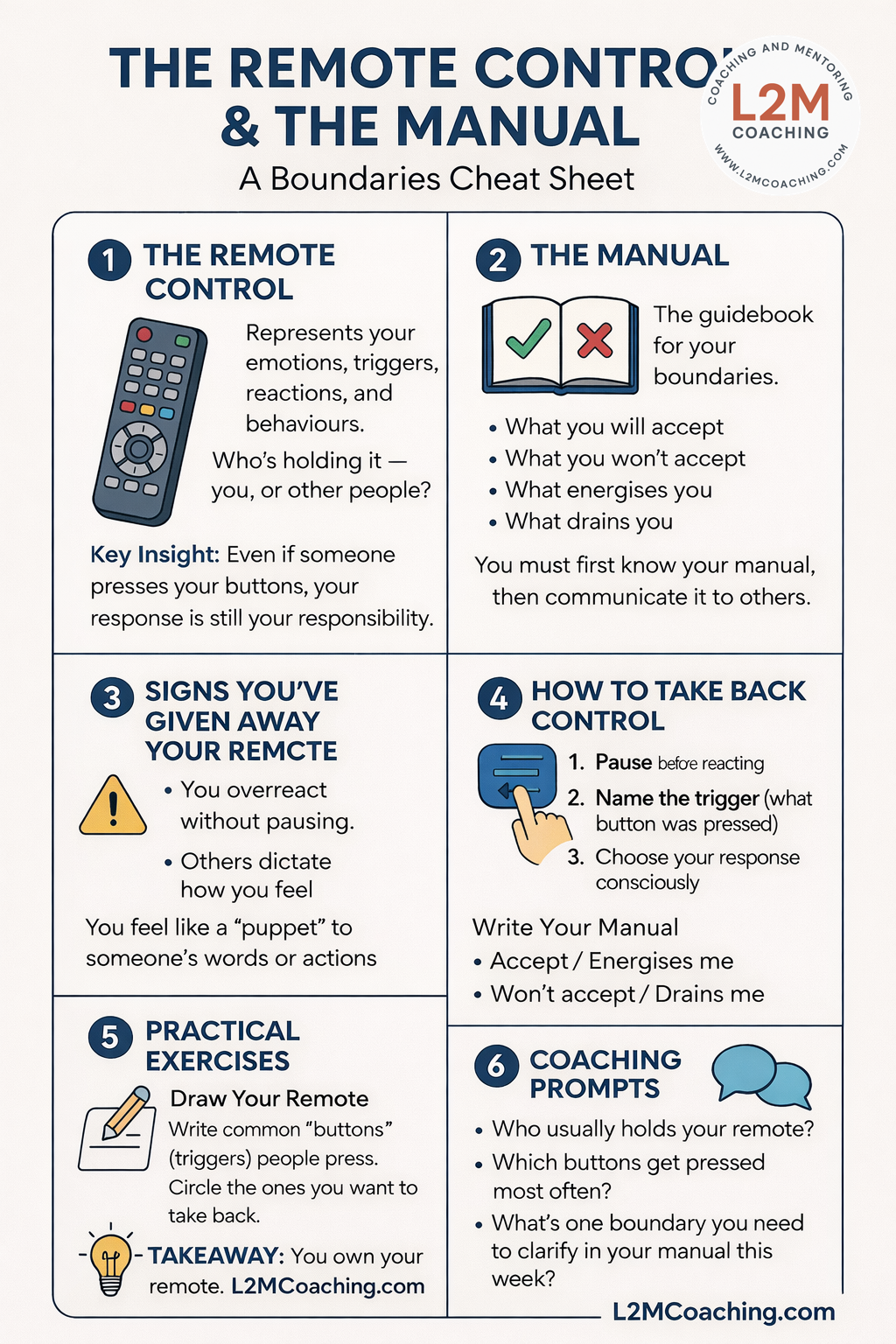
The Remote Control Metaphor
Imagine your emotional life as a television. Your thoughts, reactions, tone of voice, facial expressions & behaviours are displayed on the screen.
Now imagine there is a remote control.
Each button represents a trigger:
Someone presses one of those buttons & instantly the channel changes. Volume increases.Tone sharpens. Body language tightens. Words come out faster than intention.
In that moment, it can feel automatic.
But here is the uncomfortable truth:
They may press the button.But you still own the remote.
The Myth of “They Made Me”
No one reaches inside you and forces an emotional reaction.
What they do is stimulate something that already exists within you.
That doesn’t excuse poor behaviour. It doesn’t minimise hurt. It doesn’t deny disrespect.
But it does shift responsibility. Emotional responsibility means this:
I am responsible for how I respond even if I am not responsible for what happened.
That distinction is life-changing.
Responsibility Is Not Blame
When people hear “You’re responsible for your reaction,” they often hear criticism.
But responsibility is not blame. It is power.
Blame says:“You caused this.”
Responsibility says:“I get to choose my response.”
Blame weakens. Responsibility strengthens.
In relationships especially close ones responsibility is the difference between escalation and repair.
Why We Lose the Remote
Most of us were never taught emotional regulation.
We were taught:
But very few of us were taught:
So when someone presses a button, we react from habit, not intention.
Sometimes those habits are learned from childhood. Sometimes from cultural expectations. Sometimes from environments where emotional expression meant survival.
But unexamined habits create predictable reactions & predictable reactions hand over the remote.
The Manual: Boundaries Explained
Every remote comes with a manual.
In your emotional world, that manual represents your boundaries.
Your manual answers:
Most relational conflict is not about bad people. It is about unclear manuals.
We assume people know our boundaries.We assume they should read the signs.We assume they understand our sensitivities.
But unspoken boundaries become silent resentmentsband silent resentments eventually explode. Boundaries are not walls.They are clarity.
Parents and the Remote
If you are a parent especially of a teenager this metaphor becomes very real.
Teens are masters at pressing buttons.
Eye rolls.
Tone shifts.
Defiance.
Silence.
Sarcasm.
It is easy to react. But here is something powerful:
If your teen can predict exactly how you will respond, they are holding your remote.
That doesn’t mean you tolerate disrespect.
It means you regulate before you respond. Instead of:
“Don’t you dare speak to me like that!” You might say: “I’m happy to talk about this. I’m not okay with that tone.”
Notice what changed:
Same boundary.Different energy.Controlled response.
Children learn emotional behaviour from what they observe, not what we instruct.
Leaders and the Remote
This applies equally in leadership.
In teams, emotional contagion is real.
If a leader reacts impulsively:
If a leader regulates:
Strong leadership is not about volume.It is about stability.
A regulated leader creates regulated environment and regulated environments produce better results.
The Pause: Where Power Lives
According to Dr Victor Frankl, Between stimulus and response is a spac, That space is often milliseconds long.
But it is everything.
Without pause: Emotion drives the car.
With pause:You regain the steering wheel.
Pause might look like:
Pause is not weakness.Pause is strength under control.
Emotional Granularity: Naming Precisely
Many adults operate with a limited emotional vocabulary:
Angry.
Fine.
Stressed.
Annoyed.
But anger often masks something deeper:
When we lack emotional precision, we default to the loudest emotion available.
That is why developing emotional vocabulary matters. The more accurately you can name your emotion, the more control you gain over it.
You cannot regulate what you cannot recognise.
When Buttons Are Exposed
Instead of asking:
“Why do they keep pushing my buttons?”
Ask:
“Why are those buttons still exposed?”
What is attached to that trigger?
When you understand the root, the reaction softens.
This is deeper work.But it is transformational work.
Boundaries Without Aggression
Many people struggle with boundaries because they associate them with confrontation.
But boundaries are not about force.They are about clarity.
Examples:
“I’m open to feedback, not insults.”“I’ll continue this conversation when we’re both calm.”“That tone doesn’t work for me.”“I need space before responding.”
Clear, Calm, Firm. You are not controlling others. You are defining your participation.
“But They Started It”
This is where resistance shows up.
“Yes, but they were wrong.”“Yes, but they disrespected me.”“Yes, but they hurt me.”
You can be right and still reactive & being right does not automatically repair relationships.
Maturity means choosing who you want to be regardless of how someone else behaves.
Responsibility does not excuse harm.
It prevents escalation.
The Cost of Handing It Over
When we consistently give others control:
Over time, that erodes trust both in ourselves and in others.
It builds predictability, it builds respect, it builds safety.
Practical Daily Application
Here is what this looks like in real life:
This is emotional fitness and like physical fitness, it strengthens with repetition.
When You Change, the System Changes
Here is something powerful:
When one person changes their reaction pattern, the relationship dynamic shifts.
The person expecting escalation receives calm.The person expecting defence receives clarity. The person expecting shouting receives regulation. You cannot control others.
But you can influence the relational system by changing how you show up in it.
Final Reflection
You cannot stop people from pressing buttons.
But you can:
You own your remote.
Others may know where the buttons are.
But only you decide what happens when one is pressed.
And when you consistently hold your remote with calm authority, something changes.
You become:
More grounded.
More predictable.
More respected.
More trusted.
And healthier relationships follow.
Because relationships are not transformed by control, they are transformed by responsibility.
If you want to explore this practically not theoretically that is exactly what we work on inside L2M Coaching sessions.
Because better relationships start with one simple shift:
Reading creates awareness. Coaching creates lasting change. Book a free 30-minute conversation to explore what this could look like in your specific situation.
Discussion
No comments yet — be the first to share your thoughts.
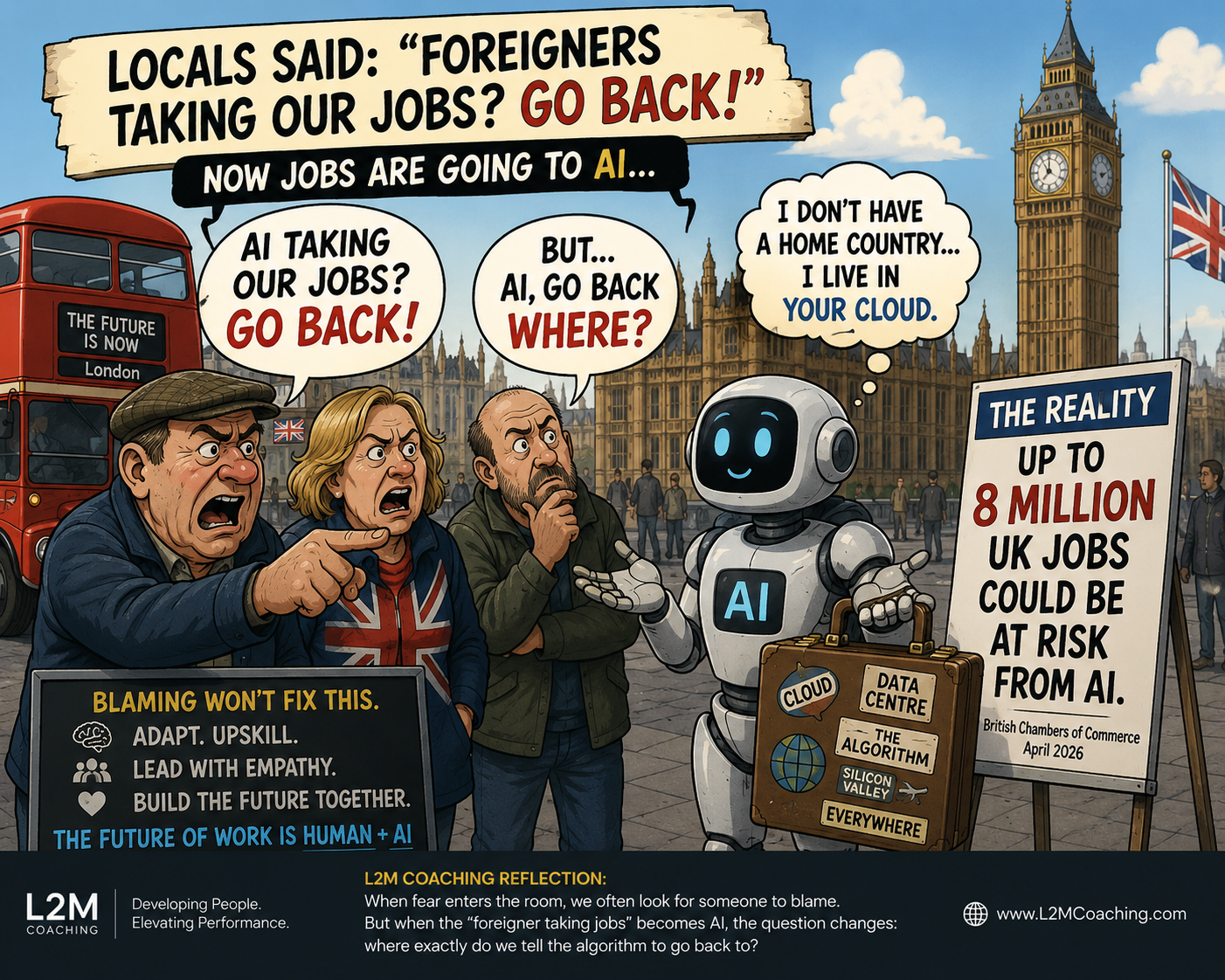
By Lloyd Munyaviri | L2MCoaching After Blaming Foreigners, Who Do We Blame When AI Takes the Jobs? For years, in many societies, when people have felt economically squeezed, one of the easiest narratives has been: “foreigners are taking our jobs.” We have heard it in the UK. We have heard it in South Africa. We have heard it in communities where people are struggling with unemployment, poor wages, insecure work, rising costs, stretched public services and a deep sense that life is becoming...
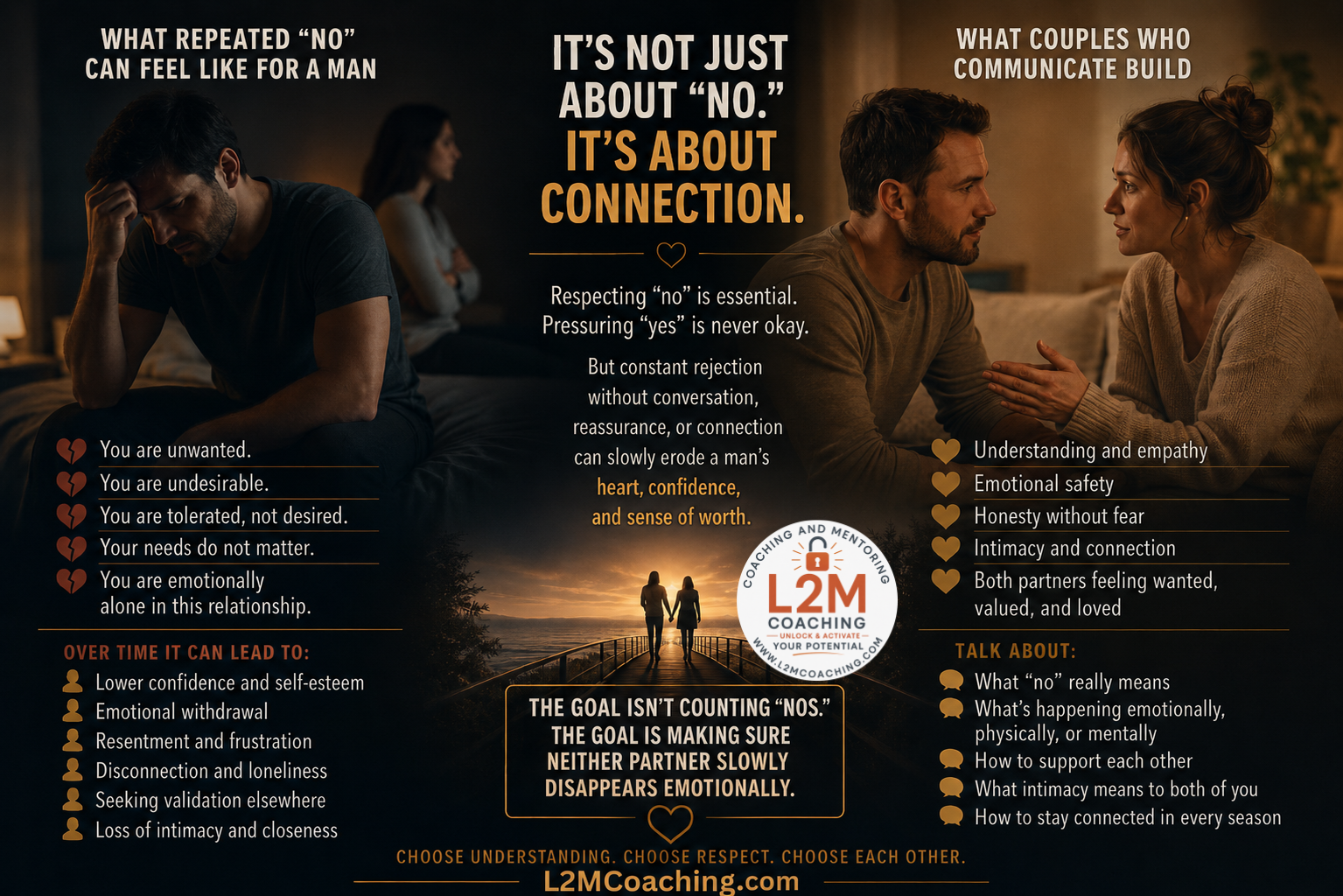
As part of the Monthly Connect Better Podcast Series we run at L2MCoaching (everyone is invited) once a month, a number of topics for discussion are suggested and this one is a popular request and I hope to do it justice: In relationships, one of the hardest conversations to have is the conversation about rejection, intimacy, emotional needs and unmet expectations. It is a sensitive subject because it can easily be misunderstood. When a partner says “no”, that “no” must be respected. No one...
Why knowledge alone is not enough and what we need to learn instead. We’ve been conditioned to believe something powerful: “Education is the answer.” Say it enough times, and it becomes truth. Build systems around it, and it becomes policy.Repeat it to selves and our children and it becomes belief. But let’s pause for a moment and ask a question that rarely gets asked: Education… then what? Because if education truly was the answer, we wouldn’t have so many educated people feeling stuck,...