What Children Soak Up: How Parenting Environment Shapes Behaviour
LM
Lloyd Munyaviri
EMCC Accredited Coach
Children learn from more than words. They learn from tone, habits, reactions, emotional safety, and what becomes normal around them. As parents, guardians and carers, we often focus on what we need to say to our children. We remind them to be kind, calm, honest, respectful and confident. Those messages matter, but children are learning from far more than direct instruction. They are also learning from the environment they grow up in. Children absorb more than advice. They take in the...
Children learn from more than words. They learn from tone, habits, reactions, emotional safety, and what becomes normal around them. As parents, guardians and carers, we often focus on what we need to say to our children. We remind them to be kind, calm, honest, respectful and confident. Those messages matter, but children are learning from far more than direct instruction. They are also learning from the environment they grow up in.
Children Learn What Feels Normal
Children are always learning what is normal.
If calm is normal, they begin to absorb calm.If shouting is normal, they begin to absorb shouting.If honesty, repair, and respect are part of daily life, those patterns begin to shape them too.
This is why parenting is not only about correcting behaviour. It is also about shaping the emotional climate children grow inside.
What children experience repeatedly often becomes what they expect, trust and repeat.
They Absorb More Than We Realise
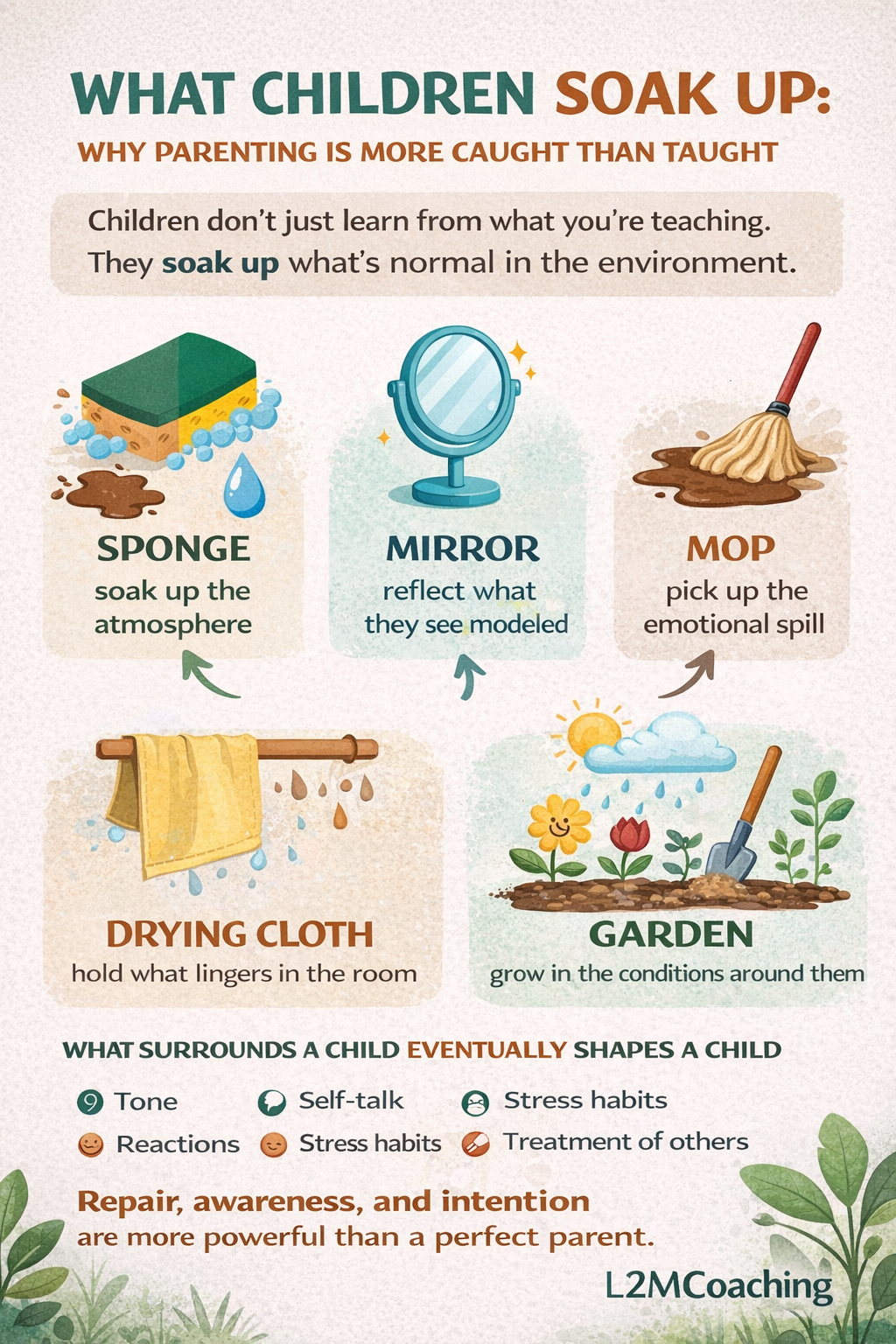
People often describe children as sponges, and that picture helps. A sponge soaks up what surrounds it.
But there are other useful ways to think about it too.
Children can be like:
Each metaphor points to the same truth:
Children absorb patterns, not just lessons. Children do not only learn through instruction. They also absorb what surrounds them every day.
Behaviour Teaches Louder Than Instruction
A parent may say, “Stay calm,” but if calm is rarely modelled, the child may learn something very different.
A parent may say, “Believe in yourself,” but if they constantly criticise themselves, the child may absorb self-judgment instead.
A parent may say, “You can talk to me,” but if honesty is met with anger, panic, or shame, the child may learn that truth is unsafe.
Children are not only listening.They are watching, feeling, and interpreting what daily life teaches them.
What Children May Be Internalising
Without anyone directly teaching it, children may be learning:
Sometimes a child’s behaviour is not just defiance.
Sometimes it is imitation.Sometimes it is adaptation.Sometimes it is a response to the emotional climate around them.
Behaviour is often communication shaped by environment.
This Is Not About Perfect Parenting
This message is not about perfection. It is about awareness. Children do not need perfect parents. They need parents who are willing to reflect, repair and grow. One of the most powerful things a parent can model is how to come back after getting it wrong.
Saying:
…teaches accountability, humility, trust, and emotional safety.
The Environment Is Always Teaching
Children notice:
In many ways, the environment becomes the lesson before words do.
That is why one of the most powerful questions a parent can ask is this:
Question to Parents & Guardians: What is my child soaking up from being around me?
Small Shifts Can Make a Big Difference
Change does not always begin with something dramatic. Often it starts with small, repeated shifts.
You might begin by:
Small changes, repeated consistently, can shape a child powerfully over time.
A Simple Reflection for Parents
Take a moment to ask yourself:
These are not easy questions, but they are powerful ones. Awareness is often where healthier parenting begins.
Final Thought
Children do not only grow from what we tell them.
They grow inside what we repeatedly show them.
So yes, keep teaching, guiding and encouraging. But also remember that what surrounds a child will often shape a child.
That is why parenting is not only about what is taught.
It is also about what is caught.
Support for Parents and Families
We can all do with some support at some point, at L2MCoaching, I support parents, teens, and families through reflective coaching that helps build emotional awareness, stronger communication, and healthier relational patterns.
If you would like support on your parenting journey, get in touch through L2MCoaching.
Reading creates awareness. Coaching creates lasting change. Book a free 30-minute conversation to explore what this could look like in your specific situation.
Discussion
No comments yet — be the first to share your thoughts.
By Lloyd Munyaviri | L2MCoaching After Blaming Foreigners, Who Do We Blame When AI Takes the Jobs? For years, in many societies, when people have felt economically squeezed, one of the easiest narratives has been: “foreigners are taking our jobs.” We have heard it in the UK. We have heard it in South Africa. We have heard it in communities where people are struggling with unemployment, poor wages, insecure work, rising costs, stretched public services and a deep sense that life is becoming...
As part of the Monthly Connect Better Podcast Series we run at L2MCoaching (everyone is invited) once a month, a number of topics for discussion are suggested and this one is a popular request and I hope to do it justice: In relationships, one of the hardest conversations to have is the conversation about rejection, intimacy, emotional needs and unmet expectations. It is a sensitive subject because it can easily be misunderstood. When a partner says “no”, that “no” must be respected. No one...
Why knowledge alone is not enough and what we need to learn instead. We’ve been conditioned to believe something powerful: “Education is the answer.” Say it enough times, and it becomes truth. Build systems around it, and it becomes policy.Repeat it to selves and our children and it becomes belief. But let’s pause for a moment and ask a question that rarely gets asked: Education… then what? Because if education truly was the answer, we wouldn’t have so many educated people feeling stuck,...