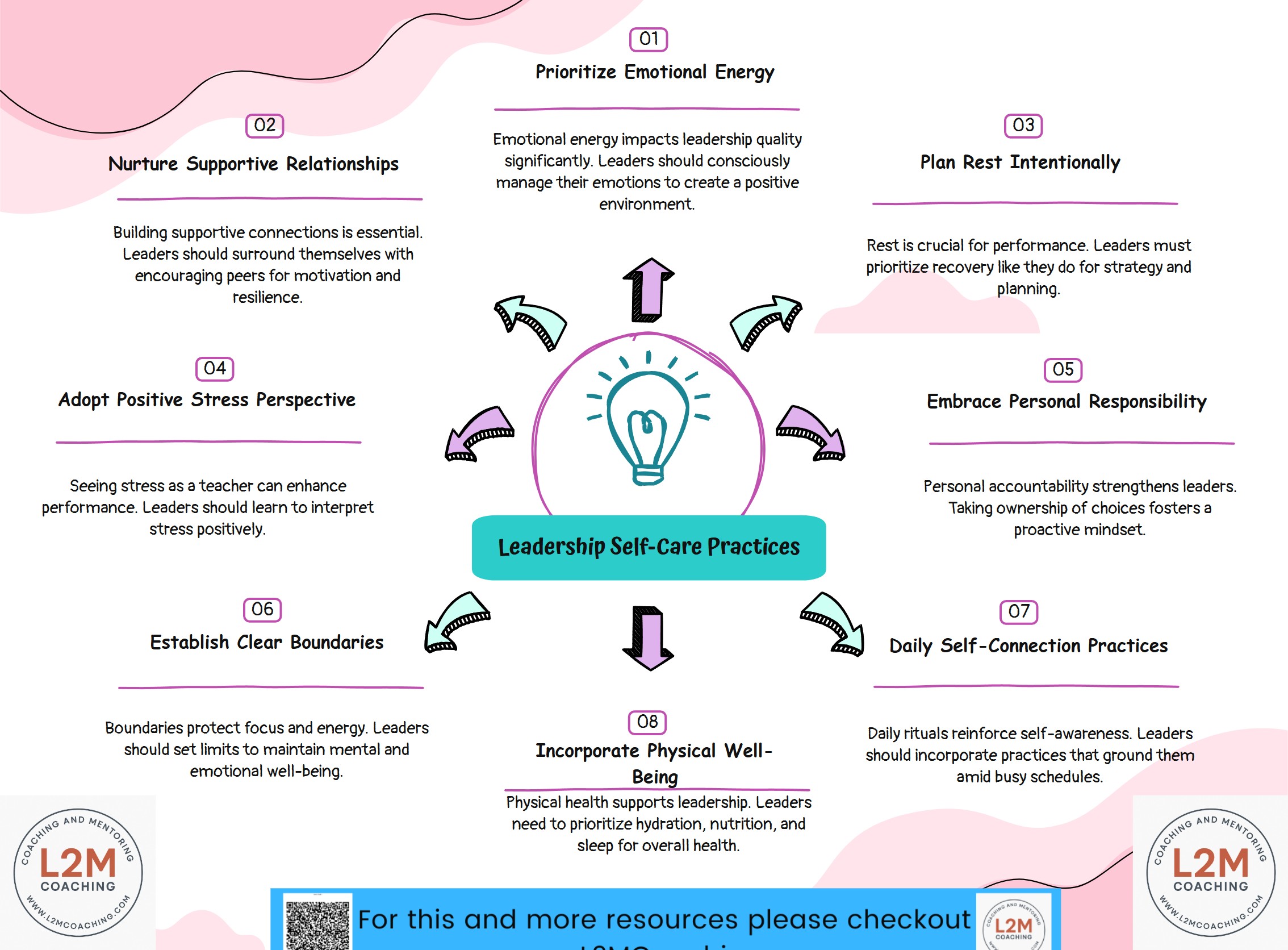
⭐ Leadership Practices for Self-Care: Protecting Your Energy, Presence & Impact
LM
Lloyd Munyaviri
EMCC Accredited Coach
Leadership is not just about strategy, execution and performance. It’s about capacity . Your capacity to think clearly.Your capacity to regulate your emotions.Your capacity to lead with presence rather than pressure. And make no mistake your capacity is fuelled by self-care . Self-care is not a luxury. It is leadership infrastructure. Below are L2M Coaching’s Leadership Practices for Self-Care a practical guide for leaders, parents, coaches, and anyone who carries responsibility. ⭐ 1....
Leadership is not just about strategy, execution and performance. It’s about capacity.
Your capacity to think clearly.Your capacity to regulate your emotions.Your capacity to lead with presence rather than pressure. And make no mistake your capacity is fuelled by self-care. Self-care is not a luxury. It is leadership infrastructure.
Below are L2M Coaching’s Leadership Practices for Self-Care a practical guide for leaders, parents, coaches, and anyone who carries responsibility.
⭐ 1. Protect Your Emotional Energy Before You Protect Your Time
Your emotional state enters the room before you do. Before the email, before the meeting, before the conversation your energy is already communicating.
Self-care begins with:
• Asking: “What energy am I bringing into this space?”
• Resetting before major conversations
• Naming emotions before they leak into behaviour
• Using a 60-second grounding ritual to re-centre
Emotionally aware leaders lead from clarity, not reactivity.
⭐ 2. Build Relationships That Hold You Up, Not Wear You Down
Leadership becomes heavier when carried alone. Healthy relationships are a form of psychological self-care.
Supportive relationships help leaders:
• Stay grounded during turbulent seasons
• See blind spots without shame
• Stay encouraged under pressure
• Feel supported instead of stretched thin
Choose relationships that replenish your confidence, not those that drain your emotional resources.
⭐ 3. Treat Rest as a Strategic Priority, Not an Afterthought
Most leaders attempt to rest after they’re exhausted which is too late. Sustainable leadership requires proactive recovery.
This means:
• Scheduling rest like you schedule strategy
• Establishing realistic stop times
• Building micro-breaks to reset your nervous system
• Protecting weekends and downtime
• Taking sleep seriously
When leaders rest, they don’t lose productivity they upgrade it.
⭐ 4. Shift Your Mindset From “Stress Is Bad” to “Stress Is Information”
Stress is not always a threat. Often, it is an alert system.
It can tell you:
• Something matters
• Something is misaligned
• Something requires attention
• Something is stretching your capacity to grow
A healthy stress mindset sounds like: “What is this moment trying to teach me?”
Instead of: “This is too much; I can’t cope.”
When leaders shift their internal narrative, they regain psychological control.
⭐ 5. Strengthen Your Internal Locus of Control
Self-care isn’t just physical it is deeply mental. Leaders become stronger when they adopt the mindset:
“I can influence this. I am not powerless.”
An internal locus of control helps you:
• Stay proactive rather than reactive
• Avoid unnecessary blame
• Remain strategic under pressure
• Maintain a strong sense of agency
Leadership grows where ownership grows.
⭐ 6. Set Boundaries That Protect Your Focus and Identity
A leader without boundaries becomes a leader without capacity. Boundaries keep your energy, time, and priorities intact.
Effective boundaries sound like:
• “I’m available until 5 PM.”
• “Let’s move this to tomorrow when I can give it the right focus.”
• “I can help, but not at the expense of my wellbeing.”
Boundaries aren’t selfish they’re clarity.
⭐ 7. Maintain a Daily Practice That Pulls You Back to Yourself
It doesn’t matter what practice you choose reflection, journaling, prayer, meditation, walking, breathwork, or silence as long as it reconnects you to you.
A daily grounding practice helps you:
• Reset emotionally
• Reconnect to your values
• Make intentional choices
• Avoid reactive behaviour
Leaders lead best when they start from inner alignment.
⭐ 8. Honour Your Body as Part of Your Leadership Toolkit
Leadership isn’t only cognitive it’s physical. Your body keeps score.
Self-care includes:
• Hydration
• Movement
• Balanced nutrition
• Deep rest
• Breathing exercises
• Recognising early signs of burnout
Your body is a leadership asset. Protect it.
⭐ 9. Lead From Your Values, Not From Pressure
Burnout often stems from living at odds with your values. When your leadership aligns with your identity, you experience less friction and greater fulfilment.
Self-care here means:
• Knowing your top values
• Leading decisions through those values
• Saying no where your values are compromised
• Staying aligned in how you lead, speak, and act
Alignment is a form of protection.
⭐ 10. Give Yourself Permission to Be Human
Leadership doesn’t require perfection it requires authenticity.
Self-care means allowing yourself to:
• Rest without guilt
• Admit when you’re overwhelmed
• Learn from mistakes without self-punishment
• Seek support without shame
Being human strengthens your leadership because it deepens your connection to others.
⭐ Final Thought: Self-Care Is Leadership Maintenance
Self-care is not the break from leadership it is the maintenance that makes leadership possible. When leaders protect their energy, they protect their teams. When leaders protect their clarity, they protect their decisions. When leaders protect their wellbeing, they protect their impact. Strong leadership is not built on self-sacrifice it’s built on self-awareness, self-respect, and self-care.
Reading creates awareness. Coaching creates lasting change. Book a free 30-minute conversation to explore what this could look like in your specific situation.
Discussion
No comments yet — be the first to share your thoughts.
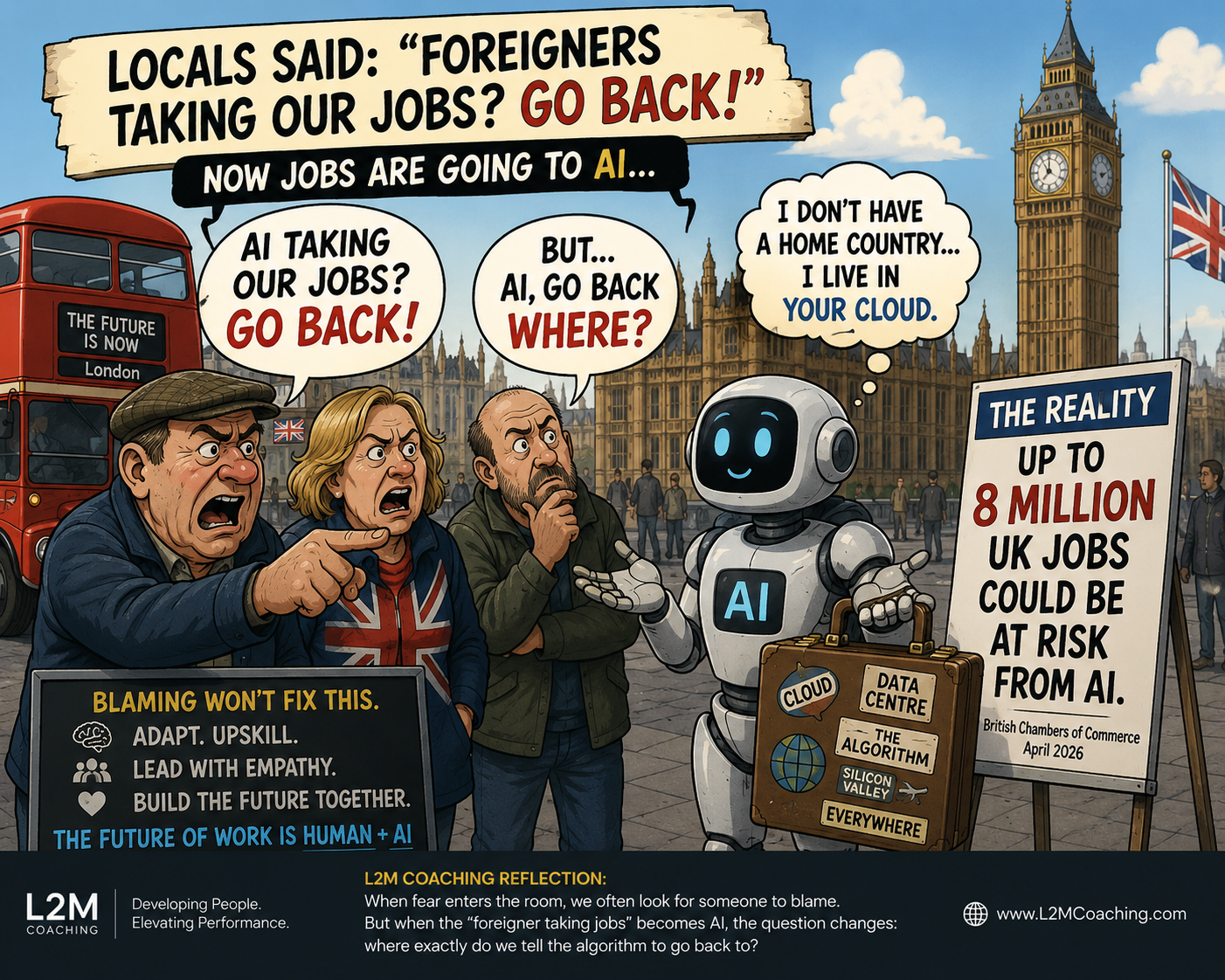
By Lloyd Munyaviri | L2MCoaching After Blaming Foreigners, Who Do We Blame When AI Takes the Jobs? For years, in many societies, when people have felt economically squeezed, one of the easiest narratives has been: “foreigners are taking our jobs.” We have heard it in the UK. We have heard it in South Africa. We have heard it in communities where people are struggling with unemployment, poor wages, insecure work, rising costs, stretched public services and a deep sense that life is becoming...
As part of the Monthly Connect Better Podcast Series we run at L2MCoaching (everyone is invited) once a month, a number of topics for discussion are suggested and this one is a popular request and I hope to do it justice: In relationships, one of the hardest conversations to have is the conversation about rejection, intimacy, emotional needs and unmet expectations. It is a sensitive subject because it can easily be misunderstood. When a partner says “no”, that “no” must be respected. No one...
Why knowledge alone is not enough and what we need to learn instead. We’ve been conditioned to believe something powerful: “Education is the answer.” Say it enough times, and it becomes truth. Build systems around it, and it becomes policy.Repeat it to selves and our children and it becomes belief. But let’s pause for a moment and ask a question that rarely gets asked: Education… then what? Because if education truly was the answer, we wouldn’t have so many educated people feeling stuck,...