shona customs: Mbariro, Ruzhowa, Gedhi & Kupwanya Ruzhowa: Shona Wisdom on Building, Protecting and Honouring the Home
LM
Lloyd Munyaviri
EMCC Accredited Coach
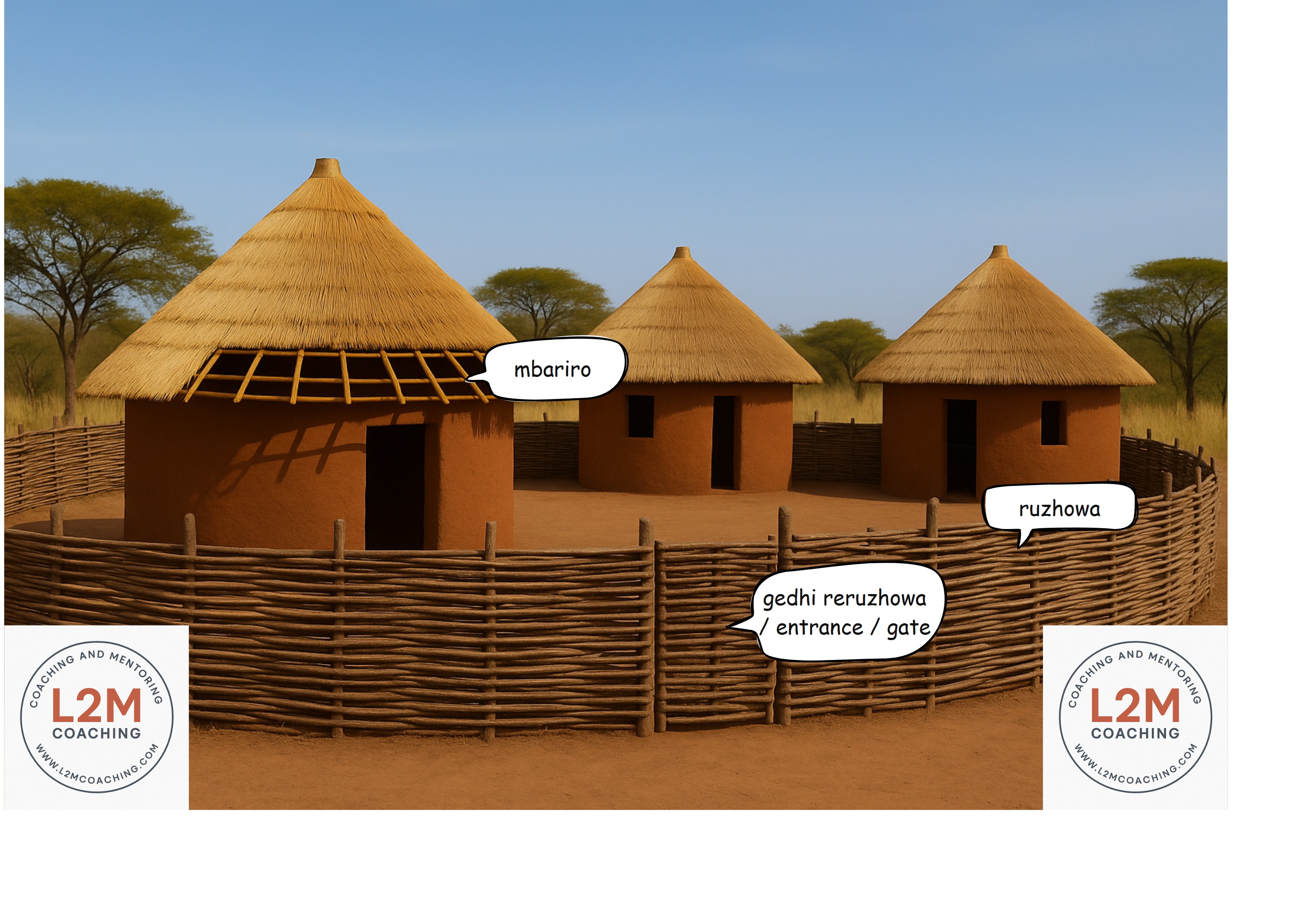
A traditional Shona homestead showing mbariro binding the roof structure of a partially thatched hut, all buildings protected within a ruzhova (perimeter fence). The gedhi (gate) marks the honoured entrance into the chivanze (courtyard), with each hut entered through its mukova (door). This image reflects the cultural balance of unity, protection, and respectful access. In Shona culture, wisdom is not abstract or theoretical. It is built into everyday life into how we construct our...
In Shona culture, wisdom is not abstract or theoretical. It is built into everyday life into how we construct our homes, organise our families, negotiate marriage and even how we sing about love, jealousy and community. Four powerful concepts capture this lived wisdom beautifully: Mbariro, Ruzhowa, Gedhi, and the marriage practice of Kupwanya Ruzhowa.
Together, they teach us how homes are built, how they are protected, how access is honoured and why respect and boundaries matter just as much as connection.
Mbariro: What Holds the Home Together
In the construction of a traditional Shona hut, mbariro are the thin or split wooden poles tied horizontally around the upright roof poles. Though light and flexible, they play a critical role.
Without mbariro, the structure cannot stand.
The vertical poles may be strong individually, but without being bound together, they cannot carry the roof. The hut collapses not because the poles are weak, but because they are disconnected.
Culturally, mbariro symbolise unity, relationships and collective strength. They represent:
This wisdom is powerfully echoed by the late Oliver Mtukudzi in his song Shanje, where he warns:
Jealousy does not build a home;it breaks the binding poles and turns them into firewood.
The message is clear: homes are not only destroyed by external storms, but by internal forces like jealousy, resentment and unresolved conflict. These quietly weaken the mbariro until what once held life together is reduced to fuel for destruction.
Ruzhowa: Protection, Boundaries and Blessing
Ruzhowa refers to the hedge or perimeter fence built around a homestead. On the surface, it serves a practical purpose, keeping animals out and protecting the household.
But culturally, ruzhowa carries deeper meaning. It symbolises:
This is why, in prayer, many Shona people say:
Ruzhowa teaches an enduring lesson: What is valuable must be protected.
Boundaries are not about exclusion; they are about care. A home without ruzhowa is exposed. A life without boundaries is vulnerable.
Gedhi: Respectful Access and Permission
The ruzhowa is not complete without gedhi - the gate/ mukova
In Shona culture, gedhi represents controlled and respectful access. One does not jump over the fence. One enters through the gate.
Gedhi symbolises:
This idea reaches far beyond architecture. It shapes how visitors enter a homestead, how relationships begin and how trust is built. You do not force entry.
You knock. You wait. You are invited in.
Only then does the gedhi open or perission to enter is granted - please note that this concepyt applies even where there is no physical ruzhowa or gedhi .... the perimeter of the homestead is the boundary / the protection / ruzhowa and you cannot just trespass without permission it is the height of disrespect.
Kupwanya Ruzhowa: Honour Before Entry
The importance of ruzhowa and gedhi becomes especially clear in Shona marriage customs, particularly in roora (lobola) negotiations. Before marriage, a young woman is understood to be protected within her family’s ruzhowa - physically, emotionally, socially and spiritually. She is not simply taken from her home. The groom’s family must formally request access through the recognised process of Kupwanya Ruzhowa — breaking the hedge.
A fee is paid, not as a purchase of a person, but as a symbolic act of respect. It acknowledges that:
Kupwanya Ruzhowa teaches humility, responsibility and accountability - values that remain deeply relevant in modern relationships.
Ruzhowa in Song: Cultural Wisdom That Still Speaks
These lessons are not frozen in tradition; they continue to live in Shona teachings like music.
In his hit song “Ruzhowa,” Jah Prayzah reminds us that love, family and legacy require protection. Boundaries preserve what matters.
Together with Mtukudzi’s warning about shanje, the message becomes complete:
Music, once again, becomes a classroom.
The Shona Homestead as a Living Diagram
A traditional Shona homestead reflects this wisdom clearly:
Nothing is accidental. Every element teaches how life should be lived.
A Reflection for Today
Take a moment to reflect:
Growth often begins with restoring what has been neglected.
Closing Wisdom
A home is built by strong bindings,protected by respected boundaries,and entered through the gate with honour.
About L2M Coaching
At L2M Coaching, we integrate African cultural wisdom with modern coaching practices to support leaders, parents, and young people to:
Reading creates awareness. Coaching creates lasting change. Book a free 30-minute conversation to explore what this could look like in your specific situation.
Discussion
No comments yet — be the first to share your thoughts.
By Lloyd Munyaviri | L2MCoaching After Blaming Foreigners, Who Do We Blame When AI Takes the Jobs? For years, in many societies, when people have felt economically squeezed, one of the easiest narratives has been: “foreigners are taking our jobs.” We have heard it in the UK. We have heard it in South Africa. We have heard it in communities where people are struggling with unemployment, poor wages, insecure work, rising costs, stretched public services and a deep sense that life is becoming...
As part of the Monthly Connect Better Podcast Series we run at L2MCoaching (everyone is invited) once a month, a number of topics for discussion are suggested and this one is a popular request and I hope to do it justice: In relationships, one of the hardest conversations to have is the conversation about rejection, intimacy, emotional needs and unmet expectations. It is a sensitive subject because it can easily be misunderstood. When a partner says “no”, that “no” must be respected. No one...
Why knowledge alone is not enough and what we need to learn instead. We’ve been conditioned to believe something powerful: “Education is the answer.” Say it enough times, and it becomes truth. Build systems around it, and it becomes policy.Repeat it to selves and our children and it becomes belief. But let’s pause for a moment and ask a question that rarely gets asked: Education… then what? Because if education truly was the answer, we wouldn’t have so many educated people feeling stuck,...