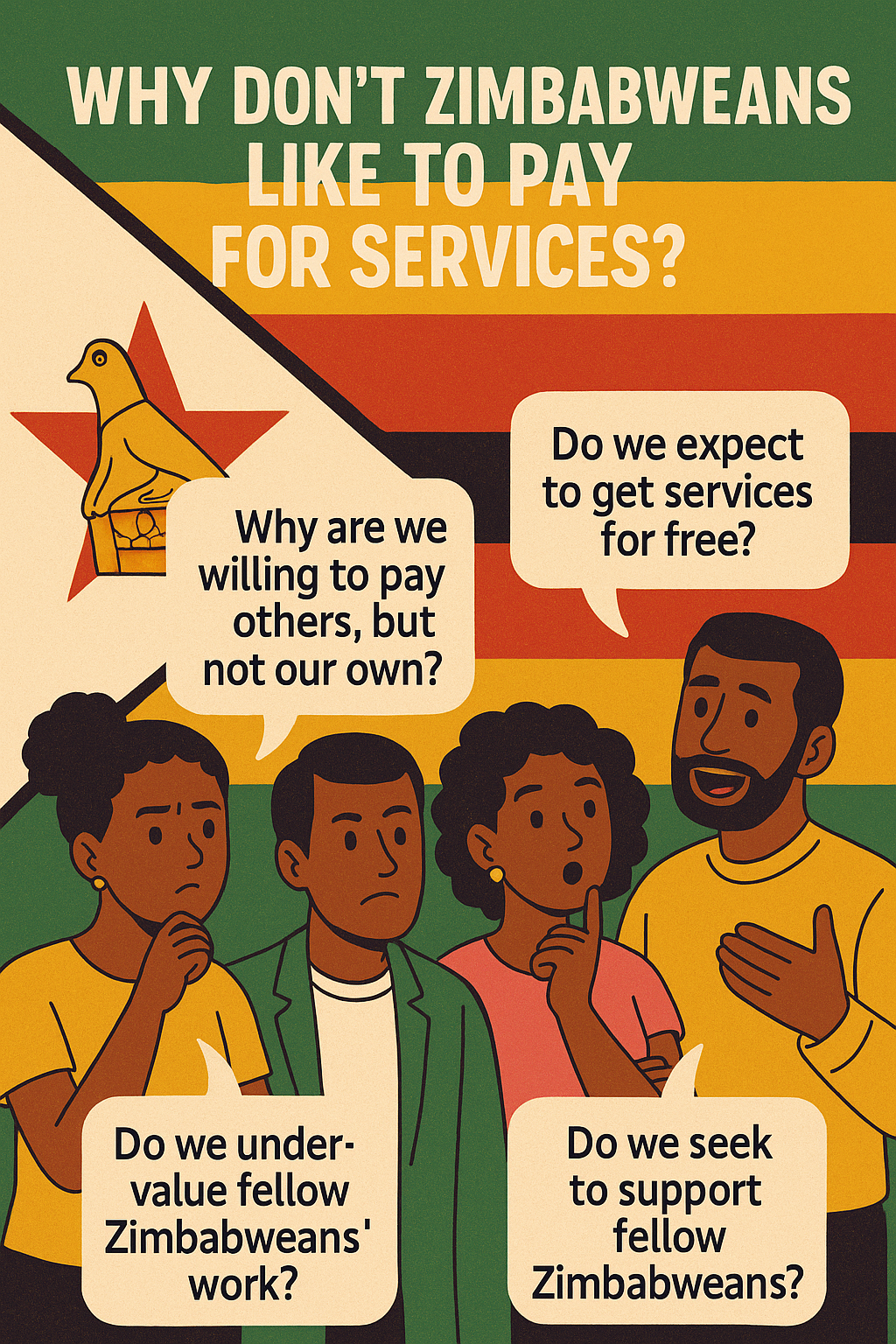
A Real Conversation About Trust, Value and Growth in the Zimbabwean Community By Lloyd Munyaviri | L2M Coaching 🌐 www.L2MCoaching.com The Question That Sparked It All In a conversation with fellow professionals and entrepreneurs, a statement came up that many found uncomfortable yet familiar: “We Zimbabweans don’t like to pay for services especially when those services come from one of our own.” It’s a sweeping generalisation, yes but is it reflective of a deeper sentiment? Why is it that...
A Real Conversation About Trust, Value and Growth in the Zimbabwean Community
By Lloyd Munyaviri | L2M Coaching🌐 www.L2MCoaching.com
The Question That Sparked It All
In a conversation with fellow professionals and entrepreneurs, a statement came up that many found uncomfortable yet familiar:
It’s a sweeping generalisation, yes but is it reflective of a deeper sentiment? Why is it that when the service provider is one of us, hesitation or bargaining often follows? Is it because we don’t see the value? Or because we think we can get it for free?
And on the other side how many of us deliberately make an effort to uplift fellow Zimbabweans by giving them business, referrals and opportunities to grow?
These questions opened up a powerful discussion one that revealed not just opinions, but lived experiences, frustrations, and hope.
🟢 A Mixed Reality
The responses made one thing clear: this issue isn’t one-sided. It’s complex, emotional, and deeply rooted in our shared history and attitudes toward trust and value.
Some shared positive experiences of genuine support clients who pay fairly, refer others, and remain loyal. Others spoke of constant bargaining, unrealistic expectations, or clients who act entitled after paying very little. Equally, customers pointed out that some Zimbabwean service providers fail to deliver missing deadlines, being inconsistent, or overpromising and underdelivering. It’s a two-way challenge: trust and consistency must be rebuilt from both sides.
🟢 The Value and Trust Gap
Several people highlighted that the issue often starts with how we perceive value.When someone we know provides a service, there’s sometimes an expectation of discounts or favours as if friendship or shared identity should come with a financial shortcut. Others noted that in some cases, service providers themselves damage trust by failing to meet standards. One person shared how they had to redo work that a fellow Zimbabwean professional had dismissed as “impossible.” Another described lending money to a close contact who never repaid it not because they couldn’t, but because they didn’t feel obliged to. These examples, though painful, reveal an underlying challenge: many of us still mix relationship and responsibility in ways that can harm both.
🟢 Professionalism, Boundaries and Consistency
Many business owners agreed that rebuilding trust starts with consistency and professionalism. When service providers set clear prices, maintain standards, and follow through on their promises, respect naturally grows. As one participant put it, “If someone can’t afford your price, that’s okay don’t lower your standards. Keep your value consistent regardless of who’s asking.” At the same time, others acknowledged that customers need to understand that good service costs money, and that gratitude should go both ways not just upward.
🟢 The Gendered Experience
Women in business offered particularly insightful reflections. One described receiving genuine support from some within the community, but also encountering others who constantly criticised, demanded discounts, or tried to undercut her work.
She shared that separating from those who drain energy or exploit goodwill made a huge difference allowing her to build a healthier circle of supportive, like-minded clients.
Interestingly, she also observed that some subgroups within the community, particularly women who intentionally collaborate, are creating models of consistent referral and mutual growth that others can learn from.
🟢 Culture, Conditioning, and Competition
A deeper thread in the discussion was how our upbringing and education shaped our approach to success.Many reflected that Zimbabweans are often taught to compete, not collaborate to strive for individual recognition rather than collective growth.
This mindset can lead to isolation in business and missed opportunities for partnership. Other communities, such as Indian or Chinese business networks, were cited as examples of how money can circulate several times within a group before leaving it.
In contrast, many Zimbabweans tend to seek external validation assuming that “outside” services are more trustworthy than local ones, even when the talent and skill are right next to us.
🟢 Hope and Shifting Mindsets
Despite the frustrations, most people agreed that things are changing.There’s growing professionalism, higher accountability, and more people intentionally choosing to support each other’s ventures. Small steps such as referring one another, paying fairly, giving constructive feedback, and keeping promises are rebuilding the trust that was once lost.
As one respondent noted, “When we remove ourselves from negativity and focus on value, respect, and reciprocity, it becomes a beautiful thing.”
💬 Final Reflection
The overall sentiment?👉🏾 Yes and No.
Yes, hesitation and mistrust exist. But no, it doesn’t define who we are not anymore.
Our community is growing, learning, and slowly redefining what it means to do business “with our own.” When we choose professionalism over shortcuts, respect over exploitation, and value over discounts, we begin to transform not just our businesses but our identity as a people. Because real progress starts the moment we decide to see each other’s worth clearly. 🌱
By Lloyd MunyaviriLeadership & Personal Development Coach | Founder, L2M Coaching🌐 www.L2MCoaching.com📍 Empowering individuals, leaders, and communities to grow with purpose and integrity.
Reading creates awareness. Coaching creates lasting change. Book a free 30-minute conversation to explore what this could look like in your specific situation.
Discussion
No comments yet — be the first to share your thoughts.
By Lloyd Munyaviri | L2MCoaching After Blaming Foreigners, Who Do We Blame When AI Takes the Jobs? For years, in many societies, when people have felt economically squeezed, one of the easiest narratives has been: “foreigners are taking our jobs.” We have heard it in the UK. We have heard it in South Africa. We have heard it in communities where people are struggling with unemployment, poor wages, insecure work, rising costs, stretched public services and a deep sense that life is becoming...
As part of the Monthly Connect Better Podcast Series we run at L2MCoaching (everyone is invited) once a month, a number of topics for discussion are suggested and this one is a popular request and I hope to do it justice: In relationships, one of the hardest conversations to have is the conversation about rejection, intimacy, emotional needs and unmet expectations. It is a sensitive subject because it can easily be misunderstood. When a partner says “no”, that “no” must be respected. No one...
Why knowledge alone is not enough and what we need to learn instead. We’ve been conditioned to believe something powerful: “Education is the answer.” Say it enough times, and it becomes truth. Build systems around it, and it becomes policy.Repeat it to selves and our children and it becomes belief. But let’s pause for a moment and ask a question that rarely gets asked: Education… then what? Because if education truly was the answer, we wouldn’t have so many educated people feeling stuck,...